Stuff

You are currently browsing the archive for the Stuff category.

So what on earth would prompt me to actually write a personal blog post after about a six-month gap?

I suppose it’s a combination of things. My daughter just started her senior year of high school, which obviously brings some rumination along the lines of how the hell did that much time pass that fast. Plus it’s Labor Day weekend, which has several weighty too-large-for-carryon chunks of personal baggage for me. I won’t go into all that, but something I ran across earlier today seriously picked the lock on my memory-closet.

It was this picture, in the middle of a bunch of other pictures of abandoned amusement parks.

Abominable Snowman From flickr user stevesobczuk

Abominable Snowman – Flickr User stevesobczuk

See, when I was a kid growing up around Atlanta through the 70s and early 80s, my family would generally end up going to Panama City Beach for vacation — often around this time of year. I didn’t know it at the time, but I benefited from a unique period in that area’s history. It was in the midst of the first big boom in tourism there, which evidently had started in the early/mid-60s (my parents told me stories of sleeping on its nearly deserted beaches in the 50s, their Chevy parked beside them). But it was before PC Beach became synonymous with MTV-style spring breakers in the 80s and 90s, and before the real estate land-grab of the 2000s which razed almost everything left of the indigenous culture (such as it was) in favor of gigantic condo developments.

I wasn’t much of a beach person even as a kid. I mean, I had fun on the beach — digging for sand crabs, daring waves to knock me down, making sand castles, and getting seriously sunburned. But for me it was all prelude to visiting the amusement parks in the area at night. Especially the “Miracle Strip Amusement Park.”
This picture in particular was of the Abominable Snowman ride, where they basically had a classic Scrambler ride inside a big dome, with the snowman crouched over the door. The snowman dome wasn’t added until I was about 12, but I have vivid memories of waiting what seemed forever to get into the dome to get slung around in the dark with giant speakers pumping Van Halen and a light show timed to the music — and especially the air conditioning inside, which made the wait all the more worthwhile. Few things are so wrapped up with my visceral memories of early adolescence.

My favorite parts of the park were the scary ones, though; and those are the parts that tap into my very early memories of the sort of thing that still scares and thrills me the most. Miracle Strip had two “dark” attractions: one was a Haunted Castle, which had cars on tracks that would take you through jarring, loud haunted-funhouse moments, including a terrifically psychedelic twirling tunnel.
The other was a walk-through attraction called the Old House, complete with a hidden passage behind a fireplace, and a balcony that would drop at an angle suddenly and blow air up from its floor to feel as though you were about to fall to the ground two floors below.
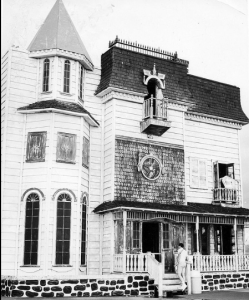
An early publicity picture for the Old House attraction from Flickr user kingpowercinema

An early publicity picture for the Old House attraction from Flickr user kingpowercinema


Read the rest of this entry »

Roughly Half Done

Yesterday I turned 45 years old. For some reason, as I got up this morning, it hit me more than it did the day before.

Here are a few thoughts about it.

I’m technically halfway to 90 years old. I hope to live even longer than that, even though it’s older than the current average age of departure. But assuming the next 45 years will result in even better technologies for keeping us alive, I’m being optimistic. Still, there’s no denying this is, officially, “middle age.”

I don’t feel middle aged though. At least not emotionally. I’m starting to learn from others that this is not unusual. We all evidently wrestle with how we perceive our relationship with “time” — which is such a reified, non-thing to begin with.

Part of me would love to feel what I assume is a level of authority and confidence that comes with hitting time-based number that most would agree is undeniably “adult.” That’s the insecure part of me, though. The one that depends on something outside of me to tell me what and who I am. On a daily basis, I have to put that part of me in “time out.” It speaks out of turn and still isn’t quite housebroken.

Nowadays I have to work harder to catch myself resting on laurels or assumptions from prior experience. My eye-roll reflex is now nimbler and quicker on the draw than when I was younger. And that’s a dangerous reflex to exercise. When I notice myself being unthinkingly dismissive of a new idea, or an old idea revived in a new situation, I feel a little like Roy Batty in Bladerunner, catching his limbs in the first stages of rigor mortis, willing them to keep moving. Luckily I don’t have to stab myself with a nail. I just have to breathe, and remember to listen more closely. (Not that I find either of those things easy; some days I’d rather stick myself with a nail.)

I’m glad I’m working in a job where the company is still finding itself, watching itself evolve. It feels more like the old meaning of “company” — a group of companions, compatriots, fellow travelers.

I’m glad I’m working on this crazy book about stuff that I still wonder if I fully understand. I’m having to learn things in order to write it, and I’m never sure if I’m fully grasping and articulating the material; but I suppose that’s better than the comfortable stasis of writing only certainties. Even though I have weekly battles of self-doubt, I’m learning so much, and accomplishing something I never thought I’d have the wherewithal to do.

My wife and I are moving again, back to Philadelphia. We’ve been wanting to finally end up someplace where we could say “this is where we live” and put down some roots, at least for a while. So we’re going back to the place where we met, and where, when we feel homesick, it’s for that place. Is this going backward? Maybe. But only if we expect to be the same people we were when we lived there before. We’re not. We’ve grown a lot in four years; changed. Plus, now we have a dog. So we’ll see.

And watching my daughter become who she is becoming. Almost 17 now. Kind, intelligent, curious, good. Her mother has worked miracles in raising her. My daughter, who has to learn her own lessons, find her own way, no matter how much her parents would like to carve a safe, happy path in front of her. What a bracing, beautiful paradox it is, to have the power to bring a human being into the world, but be so utterly powerless in the face of their own story that only they can make.

So. Halfway. Even this far into my own story, I’m still a rough draft. I suppose I’ve always felt “half done” about most things, even the ones I’ve technically finished. I’ve always felt suspended between the poles of “making” and “unmaking.” There are more days, now, when I feel at peace with that unmoored oscillation. Not many, but more.


French Toast

I’m using this post to give a home to a video clip from the show M*A*S*H. I sometimes use the clip in presentations, but it doesn’t seem to be compatible with YouTube, so I’m putting it here instead. QuickTime m4v format; just click the link to view:  French Toast

There are two things in particular that everyone struggles with on Twitter. Here are my humble suggestions as to how Twitter can do something about it.

1. The Asymmetrical Direct-Message Conundrum

What it is: User A is following user B, but User B is not following User A. User B direct-messages User A, and when User A tries to reply to that direct message, they cannot, because User B is not following them.

Fix: Give User B a way to set a message that will DM User A with some contact info automatically. Something like “Unfortunately I can’t receive direct messages from you, but please contact me at blahblah@domain.blah.” A more complicated fix that might help would be to allow User B to set an optional exception for receiving direct messages for anyone User B has direct-messaged (but whom User B is not following), for a given amount of time or a number of messages. It’s not perfect, but it will handle the majority of these occurrences.

2. The “DM FAIL”

What it is: User A means to send a direct message to User B, but accidentally tweets it to the whole wide world.

There are a couple of variations:
a) The SMS Reflex Response: User A gets a text from Twitter with a direct message from User B; User A types a reply and hits “send” before realizing it’s from Twitter and should’ve had “d username” (or now “m username” ?!?) typed before it.

b) The Prefix Fumble: User A is in same situation as above, but does realize it’s a text from Twitter — however, since they’re so used to thinking of Twitter usernames in the form of “@username” they type that out, forgetting they should be using the other prefix instead.

Fix: allow me to turn *off* the ability to create a tweet via SMS; and reply to my SMS text with a “hey you can’t do that” reminder if I forget I have it turned off and try doing it anyway. Let me turn it on and off via SMS text with commands, so if I’m stuck on a phone where I need to tweet that way, I can still do it. But so many people have smart-phones with Twitter apps, there’s no reason why I can’t receive SMS from Twitter without being able to create via SMS as well.

There you go, Twitter! My gift to you :-)

(By the by, I have no illusions that I’m the only one thinking about how to solve for these problems, and the bright designers at Twitter probably already have better solutions. But … you know, I thought I’d share, just in case … )

I remember back in 1999 working in a web shop that was a sibling company with a traditional ad firm, and thinking “do they realize that digital means more than just packaging copy & images for a new medium?”

Then over the years since, I’ve continually been amazed that most advertising & marketing pros still don’t seem to get the difference between “attention” and actual “engagement” — between momentary desire and actual usefulness.

Then I read this quote from a veteran advertising creative officer:

Instead of building digital things that had utility, we approached it from a messaging mind-set and put messaging into the space. It took us a while to realize … the digital space is completely different.

via The Future of Advertising | Page 4 | Fast Company.

I guess better late than never …

I actually love advertising at its best. Products and brands need to be able to tell great stories about themselves, and engage people’s emotions & aspirations. It’s easy to dump on advertising & marketing as out of touch and wrong-headed — but that’s lazy, it seems to me.

I appreciated the point Bill Buxton made in a talk I saw online a while back about how important the advertising for the iPod was … that it wasn’t just an added-on way to talk about the product; it was part of the whole product experience, driving much of how people felt about purchasing, using and especially *wearing* an iPod and its distinctive white earphones.

But this distinction between utility and pure message is an important one to understand, partly so we can understand how blurred the line has become between them. Back when the only way to interact with a brand was either to receive its advertising message passively, or to purchase and touch/experience its product or service — and there was precious little between — the lines were pretty clear between the message-maker and the product-creator.

These days, however, there are so many opportunities for engagement through interaction, conversation, utility and actual *use* between the initial message and the product itself.

Look at automobiles, for example: once upon a time, there were ads about cars, and then there were the actual cars … and that was pretty much it. But now we get a chance to build the car online, read about it, imagine ourselves in it with various options, look for reviews about it, research prices … all of that before we actually touch the car itself. By the time you touch the car, so much physical engagement has happened on your way to the actual object that your experience is largely shaped already — the car is going to feel different to you if that experience was positive rather than if it was negative (assuming a negative experience didn’t dissuade you from going for a test drive at all).

Granted to some degree that’s always been the case. The advertising acts like the label on a bottle of wine — shaping the expectation of the experience inside the bottle, which we know can make a huge difference.  But the utility experience brings a whole new, physical dimension that affects perception even more: the ability to engage the car interactively rather than passively receiving “messaging” alone. Now it’s even harder to answer the question “where does the messaging end and the car begin?”

Quick

mother always called it the quick
so that was always still is its name
that bit of fingerflesh around the nail sewn
by magic into the wrapped fingerprint we all have
embossed on our extremities unique index thick
opposing thumb she might catch me gnawing and when she did

she’d say be careful or you’ll be done
chewed it all down into the quick

my teeth pulling at the splinter of skin going thicker
into the sensitive crease it should have a name
that crease but I’ve not heard should have
taught me something the way it hurt like a sewing

needle pressed and wriggled so
it reddens swells maybe bleeds she did
warn me I should have listened I should have
that moment back but watch it skitter away so quickly
what if every moment had a name
we could never remember them no matter how thick

the books where we kept them and no matter how thick
the shelves to keep the books no matter how stiff the spines are sewn
our very lives would burn them history’s fuel a comet trail of names
of moments and minutes hours and days what’s done
and undone it was years before I learned that quick
means alive versus dead and dead the part I’d chew until I had

hit nerve that bleeding cuticle sting that has
a lesson someplace about blood that nothing is thicker
and what we know about moments that nothing is quicker
see how simple children could sing it on a seesaw
tick tock up down until the shrill bathtime mothercall but do
you leave no you play until snatched awake by your full name

hurled from the kitchen door a great net woven of your name
and you’re waving goodbye to the neighbor boy who has
that same blue jacket from last year and in just a minute you don’t
quite see him in the dusk that descended so soon so thick
just the glow of clouds stretched pink raw and sewn
with veins of yellowing light and suddenly your steps are quicker

until you find yourself under the thick blanket with the soft-sewn
edge tucked under your chin quick quick tick tock sleep has
taken you alive even though it doesn’t know your name

roadsigns

I’ve recently run across some stories involving Pixar, Apple and game design company Blizzard Entertainment that serve as great examples of courageous redirection.

What I mean by that phrase is an instance where a design team or company was courageous enough to change direction even after huge investment of time, money and vision.

Changing direction isn’t inherently beneficial, of course. And sometimes it goes awry. But these instances are pretty inspirational, because they resulted in awesomely successful user-experience products.

Work colleague Anne Gibson recently shared an article at work quoting Steve Jobs talking about Toy Story and the iPhone. While I realize we’re all getting tired of comparing ourselves to Apple and Pixar, it’s still worth a listen:

At Pixar when we were making Toy Story, there came a time when we were forced to admit that the story wasn’t great. It just wasn’t great. We stopped production for five months…. We paid them all to twiddle their thumbs while the team perfected the story into what became Toy Story. And if they hadn’t had the courage to stop, there would have never been a Toy Story the way it is, and there probably would have never been a Pixar.

(Odd how Jobs doesn’t mention John Lasseter, who I suspect was the driving force behind this particular redirection.)

Jobs goes on to explain how they never expected to run into one of those defining moments again, but that instead they tend to run into such a moment on every film at Pixar. They’ve gotten better at it, but “there always seems to come a moment where it’s just not working, and it’s so easy to fool yourself – to convince yourself that it is when you know in your heart that it isn’t.

That’s a weird, sinking feeling, but it’s hard to catch. Any designer (or writer or other craftsperson) has these moments, where you know something is wrong, but even if you can put your finger on what it is, the momentum of the group and the work already done creates a kind of inertia that pushes you into compromise.

Design is always full of compromise, of course. Real life work has constraints. But sometimes there’s a particular decision that feels ultimately defining in some way, and you have to decide if you want to take the road less traveled.

Jobs continues with a similar situation involving the now-iconic iPhone:

We had a different enclosure design for this iPhone until way too close to the introduction to ever change it. And I came in one Monday morning, I said, ‘I just don’t love this. I can’t convince myself to fall in love with this. And this is the most important product we’ve ever done.’ And we pushed the reset button.

Rather than everyone on the team whining and complaining, they volunteered to put in extra time and effort to change the design while still staying on schedule.

Of course, this is Jobs talking — he’s a master promoter. I’m sure it wasn’t as utopian as he makes out. Plus, from everything we hear, he’s not a boss you want to whine or complain to. If a mid-level manager had come in one day saying “I’m not in love with this” I have to wonder how likely this turnaround would’ve been. Still, an impressive moment.

You might think it’s necessary to have a Steve Jobs around in order to achieve such redirection. But, it’s not.

Another of the most successful products on the planet is Blizzard’s World of Warcraft — the massively multiplayer universe with over 10 million subscribers and growing. This brand has an incredibly loyal following, much of that due to the way Blizzard interacts socially with the fans of their games (including the Starcraft and Diablo franchises).

Gaming news site IGN recently ran a thorough history of Warcraft, a franchise that started about fifteen years ago with an innovative real-time-strategy computer game, “Warcraft: Orcs & Humans.”

A few years after that release, Blizzard tried developing an adventure-style game using the Warcraft concept called Warcraft Adventures. From the article:

Originally slated to release in time for the 1997 holidays, Warcraft Adventures ran late, like so many other Blizzard projects. During its development, Lucas released Curse of Monkey Island – considered by many to be the pinnacle of classic 2D adventures – and announced Grim Fandango, their ambitious first step into 3D. Blizzard’s competition had no intention of waiting up. Their confidence waned as the project neared completion …

As E3 approached, they took a hard look at their product, but their confidence had already been shattered. Curse of Monkey Island’s perfectly executed hand-drawn animation trumped Warcraft Adventures before it was even in beta, and Grim Fandango looked to make it downright obsolete. Days before the show, they made the difficult decision to can the project altogether. It wasn’t that they weren’t proud of the game the work they had done, but the moment had simply passed, and their chance to wow their fans had gone. It would have been easier and more profitable to simply finish the game up, but their commitment was just that strong. If they didn’t think it was the best, it wouldn’t see the light of day.

Sounds like a total loss, right?

But here’s what they won: Blizzard is now known for providing only the best experiences. People who know the brand do not hesitate to drop $50-60 for a new title as soon as it’s available, reviews unseen.

In addition, the story and art development for Warcraft Adventures later became raw material for World of Warcraft.

I’m aware of some other stories like this, such as how Flickr came from a redirection away from making a computer game … what are some others?

The excellent Neuroanthropology blog offers up a terrific list of links to recent research & articles covering topics like Design, Research, Addiction and Art Criticism. Check it out!

Jonah Lehrer explains the import of a study described in Science.

The larger implication is that the birth of human culture was triggered by a new kind of connectedness. For the first time, humans lived in dense clusters, and occasionally interacted with other clusters, which allowed their fragile innovations to persist and propagate. The end result was a positive feedback loop of new ideas.

Sounds an awful lot like what the Internet is doing, no?

There’s been a recent brouhaha in the political blogosphere about whether or not it’s ethical to publish under a pseudonym. And a lot of the debate seems to me to have missed an important point.

There’s a difference between random, anonymous pot-shot behavior and creating a secondary persona. It could very well be that a writer has good reason to create a second self to be the vehicle for expression. The key to this facet of identity is reputation.

In order to gain any traction in the marketplace of ideas, one must cultivate a consistent persona, over time. In effect, the writer has to create a separate identity — but it’s an identity just the same. Its reputation stands on its behavior and its words. If the author is invested at all in that identity, then its reputation is very important to the author, just like their “real” identity and reputation.

The Internet is full of examples where regular people have joined a discussion board, or started an anonymous blog or Live Journal and, before they know it, they have friendships and connections that are important to them in that parallel world of writing, sharing and discussion. Whether those people know the writer’s real name or not becomes beside the point. (Sherry Turkle and others have been exploring these ideas about identity online for many years now.)

What publishing has provided us, definitely since the printing press and especially since the Internet, is the ability to express ideas as *ideas* with very little worry about real-life baggage, anxieties, expectations and relationships getting in the way. It’s a marketplace where the ideas and their articulation can stand on their own.

Of course, history shows a long tradition of pseudonyms. Benjamin Franklin and Alexander Hamilton wrote under pseudonyms in order to make their points (Franklin as “Mrs Silence Dogood” and later — as an open secret — “Poor Richard”) and Hamilton as “Publius” (which happens to be the pseudonym adopted by the blogger at the center of the disagreement mentioned above). Other writers modified or changed their names so as to improve their chances of publication or being taken seriously. Marian Evans was able to publish brutally, psychologically frank fiction, partly because she published under the name George Eliot. And Samuel Clemens famously wrote under the name Mark Twain, as a way to reinvent his whole identity. While all of these don’t fit a precise pattern, the point is that publishing has always had generally accepted innovations involving the writer’s identity.

None of this is to say that anonymity doesn’t come with a downside. It certainly does. But lumping all anonymous or pseudonym-written writers into the same category doesn’t help.

It appears someone has posted the now-classic episode of Nightline about Ideo (called the Deep Dive) to YouTube. I hope it’s legit and Disney/ABC isn’t going to make somebody take them down. But here’s the link, hoping that doesn’t happen.

About 10 years ago, I started a job as an “Internet Copywriter” at a small web consultancy in North Carolina. By then, I’d already been steeped in the ‘net for seven or eight years, but mainly as a side-interest. My day jobs had been web-involved but not centrally, and my most meaningful learning experiences designing for the web had been side projects for fun. When I started at the new web company job, I knew there would need to be more to my role than just “concepting” and writing copy next to an art director, advertising-style. Our job was to make things people could *use* not just look at or be inspired to action by. But to be frank, I had little background in paid design work.

I’d been designing software of one kind or another off and on for a while, in part-time jobs while in graduate school. For example, creating a client database application to make my life easier in an office manager job (and then having to make it easy enough for the computer-phobic clerical staff to use as well). But I’d approached it as a tinkerer and co-user — making things I myself would be using, and iterating on them over time. (I’d taken a 3-dimensional design class in college, but it was more artistically focused — I had yet to learn much at all about industrial design, and had not yet discovered the nascent IA community, usability crowd, etc.)

Then I happened upon a Nightline broadcast (which, oddly, I never used to watch — who knows why I had it on at this point) where they engaged the design company Ideo. And I was blown away. It made perfect sense… here was a company that had codified an approach to design that I had been groping for intuitively, but not fully grasped and articulated. It put into sharp clarity a number of crucial principles such as behavioral observation and structured creative anarchy.

I immediately asked my new employer to let me order the video and share it with them. It served as a catalyst for finding out more about such approaches to design.

Since then, I’ve of course become less fully enamored of these videos… after a while you start to see the sleight-of-hand that an edited, idealized profile creates, and how it was probably the best PR event Ideo ever had. And ten years gives us the hind-sight to see that Ideo’s supposedly genius shopping cart didn’t exactly catch on — in retrospect we see that it was a fairly flawed design in many ways (in a busy grocery store, how many carts can reasonably be left at the end-caps while shoppers walk about with the hand-baskets?).

But for anyone who isn’t familiar with the essence of what many people I know call “user experience design,” this show is still an excellent teaching tool. You can see people viscerally react to it — sudden realization about how messy design is, by nature, how interdependent it is with physically experiencing your potential users, how the culture needed for creative collaboration has to be cultivated, protected from the Cartesian efficiencies and expectations of the traditional business world, and how important it is to have effective liaisons between those cultures, as well as a wise approach to structuring the necessary turbulence that creative work brings.

Then again, maybe everybody doesn’t see all that … but I’ve seen it happen.

What I find amazing, however, is this: even back then, they were saying this was the most-requested video order from ABC. This movie has been shown countless times in meetings and management retreats. And yet, the basic approach is still so rare to find. The Cartesian efficiencies and expectations form a powerful presence. What it comes down to is this: making room for this kind of work to be done well is hard work itself.

And that’s why Ideo is still in business.

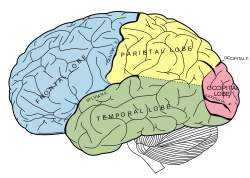
Brain (from Wikipedia)

Lately, I can’t seem to get enough of learning about brain science — neurological stuff, psychological stuff, whatever. Bring it on. There’s an amazing explosion of learning going on about our brains, and our minds (and how our brains give rise to our minds, and vice-versa).

I can’t help but think this is all great news for designers of all stripes. How can it but help for us to better understand how cognition works, how we make decisions, how our identities are formed and change over time, or even what it means for us to be happy? There are a few really excellent articles I’ve run across recently (and seen lots of folks linking to from Twitter as well).

First, this beautifully written, deeply human piece in The Atlantic on “What Makes Us Happy?” It follows a unique, longitudinal study of a generation of men who were first measured and tracked at Harvard in the 30s, as mere teenagers. It’s deftly honest about the inherent limitations in such work, but shows how valuable the results have been anyway. Mainly it’s worth reading because of its poignancy and introspection.

Another article: “Don’t! The Secret of Self Control” is from Jonah Lehrer, who’s fast becoming the Carl Sagan of Neuroscience. (And I mean that in nothing but a good way.) It looks at discoveries regarding delayed gratification, and how it’s connected to intelligence, maturity and general life success over time.

And another from the New Yorker: “Brain Games” about behavioral neurologist Vilayanur S. Ramachandran, who has figured in a number of things I’ve heard and read lately about brain science. (Reading the article requires free registration, but do read it!) I found myself wishing I could quit my job and go to UC San Diego for a completely unnecessary degree, just so I could have regular conversations with this guy and his colleagues. Among the coolest stuff discussed: how deeply social we are without even knowing it, how we construct our identities, and the possibility that we might measurably discover how human consciousness emerged, and how it works.

I can’t get over how exciting all this subject matter is to me. I suppose it’s because it combines all my favorite stuff … it’s answering questions that philosophy, theology and the creative arts have been gnawing at for generations.

« Older entries