
Information Architecture

You are currently browsing the archive for the Information Architecture category.

Context Management

Note: a while back, Christian Crumlish & Erin Malone asked me to write a sidebar for a book they were working on … an ambitious tome of design patterns for social software. The book, (Designing Social Interfaces) was published last year, and it’s excellent. I’m proud to be part of it. Christian encouraged contributors to publish their portions online … I’m finally getting around to doing so.

In addition to what I’ve posted below, I’ll point out that there have been several infamous screw-ups with context management since I wrote this … including Google Buzz and Facebook’s Groups, Places and other services.

Also to add: I don’t think we need a new discipline for context management. To my mind, it’s just good information architecture.

——————

There was a time when we could be fairly certain where we were at any given time. Just looking at one’s surroundings would let us know if we were in a public park or a quiet library, a dance hall or a funeral parlor. And our actions and conversations could easily adapt to these contexts: in a library, we’d know not to yell “heads up” and toss a football, and we’d know to avoid doing the hustle during someone’s eulogy.

But as more and more of our lives are lived via the web, and the contexts we inhabit are increasingly made of digits rather than atoms, our long-held assumptions about reality are dissolving under our typing-and-texting fingertips.

A pre-web example of this problem is something most people have experienced: accidentally emailing with “reply all” rather than “reply.”  Most email applications make it brutally easy to click Reply All by accident. In the physical world in which we evolved, the difference between a private conversation and a public one required more physical effort and provided more sensory clues. But in an email application, there’s almost no difference:  the buttons are usually identical and only a few pixels apart.

You’d think we would have learned something from our embarrassments with email, but newer applications aren’t much of an improvement. Twitter, for example, allows basically the same mistake if you use “@” instead of “d.” Not only that, but you have to put a space after the “d.”

Twitter users, by the time of this writing, are used to seeing at least a few of these errors made by their friends every week, usually followed by another tweet explaining that was a “mis-tweet” or cursing the d vs @ convention.

At least with those applications, it’s basically a binary choice for a single piece of data: one message goes either to one or multiple recipients: the contexts are straightforward, and relatively transparent. But on many popular social nework platforms, the problem becomes exponentially more complicated.

Because of its history, Facebook is an especially good example. Facebook started as a social web application with a built-in context: undergraduates at Harvard. Soon it expanded to other colleges and universities, but its contextual architecture continued to be based on school affiliation. The power of designing for a shared real-world context allowed Facebook’s structure to assume a lot about its users: they would have a lot in common, including their ages, their college culture, and circles of friends.

Facebook’s context provided a safe haven for college students to express themselves with their peers in all their immature, formative glory; for the first time a generation of late-teens unwittingly documented their transition to adulthood in a published format. But it was OK, because anybody on Facebook with them was “there” only because they were already “there” at their college, at that time.

But then, in 2006 when Facebook opened its virtual doors to anyone 13 or over with an email address, everything changed.  Graduates who were now starting their careers found their middle-aged coworkers asking to be friends on Facebook. I recall some of my younger office friends reeling at the thought that their cube-mates and managers might see their photos or read their embarrassing teenage rants “out of context.”

The Facebook example serves a discussion of context well because it’s probably the largest virtual place to have ever so suddenly unhinged itself from its physical place. Its inhabitants, who could previously afford an assumed mental model of “this web place corresponds to the physical place where I spent my college years,” found themselves in a radically different place. A contextual shift that would have required massive physical effort in the physical world was accomplished with a few lines of code and the flip of a switch.

Not that there wasn’t warning. The folks who run Facebook had announced the change was coming. So why weren’t more people ready? In part because such a reality shift doesn’t have much precedent; few people were used to thinking about the implications of such a change. But also because the platform didn’t provide any tools for managing the context conversion.

This lack of tools for managing multiple contexts is behind some of the biggest complaints about Facebook and social network platforms (such as MySpace and LinkedIn). For Facebook, long-time residents realized they would like to still keep up their immature and embarrassing memories from college to share just with their college friends, just like before — they wanted to preserve that context in its own space. But Facebook provided no capabilities for segmenting the experience. It was all or nothing, for every “friend” you added. And then, when Facebook launched its News feed — showing all your activities to your friends, and those of your friends to you — users rebelled in part because they hadn’t been given adequate tools for managing the contexts where their information might appear. This is to say nothing of the disastrous launch of Facebook’s “Beacon” service, where all users were opted in by default to share information about their purchases on other affiliated sites.

On MySpace, the early bugbear was the threat of predator activity and the lack of privacy. Again, the platform was built with the assumption that users were fine with collapsing their contexts into one space, where everything was viewable by every “friend” added. And on LinkedIn, users have often complained the platform doesn’t allow them to keep legitimate peer connections separate from others such as recruiters.

Not all platforms have made these mistakes. The Flickr photo site has long distinguished between Family and Friends, Private and Public. LiveJournal, a pioneering social platform, has provided robust permissions controls to its users for years, allowing creation of many different user-and-group combinations.

However, there’s still an important missing feature, one which should be considered for all social platforms even as they add new context-creation abilities. It’s either impossible or difficult for users to review their profiles and posts from others’ point of view.

Giving users the ability to create new contexts is a great step, but they also need the ability to easily simulate each user-category’s experience of their space. If a user creates a “co-workers” group and tries to carefully expose only their professional information, there’s no straightforward way to view their own space using that filter. With the Reply All problem described earlier, we at least get a chance to proof-read our message before hitting the button. But most social platforms don’t even give us that ability.

This function — perhaps call it “View as Different User Type” — is just one example of a whole class of design patterns we still need for managing the mind-bending complexity we’ve created for ourselves on the web. There are certainly others waiting to be explored. For example, what if we had more than just one way to say “no thank you” to an invitation or request, depending on type of person requesting? Or a way to send a friendly explanatory note with your refusal, thereby adding context to an otherwise cold interaction? Or what about the option to simply turn off whole portions of site functionality for some groups and not others? Maybe I’d love to get zombie-throwing-game invitations from my relatives, but not from people I haven’t seen since middle school?

In the rush to allow everyone to do everything online, designers often forget that some of the limitations of physical life are actually helpful, comforting, and even necessary. We’re a social species, but we’re also a nesting species, given to having our little nook in the tribal cave. Maybe we should take a step back and think of these patterns not unlike their originator, Mr Alexander, did — how have people lived and interacted successfully over many generations? What can we learn from the best of those structures, even in the structureless clouds of cyberspace? Ideally, the result would be the best of both worlds: architectures that fit our ingrained assumptions about the world, while giving us the magical ability to link across divides that were impossible to cross before.
I’ve written a lot of stuff over the last few years about information architecture. And I’m working on writing more. But recently I’ve realized there are some things I’ve not actually posted publicly in a straightforward, condensed manner. (And yes, the post below is, for me, condensed.)

WTF is IA?

1. Information architecture is not just about organizing content.

  • In practice, it has never been limited to merely putting content into categories, even though some very old definitions are still floating around the web that define it as such. (And some long-time practitioners are still explaining it this way, even though their actual work goes beyond those bounds.)
  • Every competent information architecture practitioner I’ve ever known has designed for helping people make decisions, or persuade customers, or encourage sharing and conversation where relevant. There’s no need to coin new things like “decision architecture” and “persuasion architecture.”
  • This is not to diminish the importance and complexities involved with designing storage and access of content, which is actually pretty damn hard to do well.

2. IA determines the frameworks, pathways and contexts that people (and information) are able to traverse and inhabit in digitally-enabled spaces.

  • Saying information architecture is  limited to how people interact with information is like saying traditional architecture is limited to how people interact with wood, stone, concrete and plastic.
  • That is: Information architecture uses information as its raw material the same way building architecture uses physical materials.
  • All of this stuff is essentially made of language, which makes semantic structure centrally important to its design.
  • In cyberspace, where people can go and where information can go are essentially the same thing; where and how people can access information and where and how people can access one another is, again, essentially the same thing. To ignore this is to be doing IA all wrong.

3. The increase of things like ubiquitous computing, augmented reality, emergent/collective organization and “beyond-the-browser” experiences make information architecture even more relevant, not less.

  • The physical world is increasingly on the grid, networked, and online. The distinction between digital and “real” is officially meaningless. This only makes IA more necessary. The digital layer is made of language, and that language shapes our experience of the physical.
  • The more information contexts and pathways are distributed, fragmented, user-generated and decentralized, the more essential it is to design helpful, evolving frameworks, and conditional/responsive semantic structures that enable people to communicate, share, store, retrieve and find “information” (aka not just “content” but services, places, conversations, people and more).
  • Interaction design is essential to all of this, as is graphical design, content strategy and the rest. But those things require useful, relevant contexts and connections, semantic scaffolding and … architecture! … to ensure their success. (And vice versa.)

Why does this need to be explained? Why isn’t this more clear? Several reasons:

1. IA as described above is still pretty new, highly interstitial, and very complex; its materials are invisible, and its effects are, almost by definition, back-stage where nobody notices them (until they suck). We’re still learning how to talk about it. (We need more patience with this — if artists, judges, philosophers and even traditional architects can still disagree among one another about the nature of their fields, there’s no shame in IA following suit.)

2. Information architecture is a phrase claimed by several different camps of people, from Wurmanites (who see it as a sort of hybrid information-design-meets-philosophy-of-life) to the polar-bear-book-is-all-I-need folks, to the information-technology systems architects and others … all of whom would do better to start understanding themselves as points on a spectrum rather than mutually exclusive identities.

3. There are too many legacy definitions of IA hanging around that need to be updated past the “web 1.0” mentality of circa 2000. The official explanations need to catch up with the frontiers the practice has been working in for years now. (I had an opportunity to fix this with IA Institute and dropped the ball; glad to help the new board & others in any way I can, though.)

4. Leaders in the community have the responsibility to push the practice’s understanding of itself forward: in any field, the majority of members will follow such a lead, but will otherwise remain in stasis. We need to be better boosters of IA, and calling it what it is rather than skirting the charge of “defining the damn thing.”

5. Some leaders (and/or loud voices) in the broader design community have, for whatever reason, decided to reject information architecture or, worse, continue stoking some kind of grudge against IA and people who identify as information architects. They need to get over their drama, occasionally give people the benefit of the freakin’ doubt, and move on.

Update:

This has generated a lot of excellent conversation, thanks!

A couple of things to add:

After some prodding on Twitter, I managed to boil down a single-statement explanation of what information architecture is, and a few folks said they liked it, so I’m tacking it on here at the bottom: “IA determines what the information should be, where you and it can go, and why.” Of course, the real juice is in the wide-ranging implications of that statement.

Also Jorge Arango was awesome enough to translate it into Spanish. Thanks, Jorge!

When I ran for the IA Institute board a couple of years ago, I’d never been on a board of anything before. I didn’t run because I wanted to be on a board at all, really. I ran because I had been telling board members stuff I thought they should focus on, and making pronouncements about what I thought the IA Institute should be, and realized I should either join in and help or shut up about it.

So I ran, and thanks to the membership of the Institute that voted for me, I was voted into a slot on the board.

It didn’t take long to realize that the organization I’d helped (in a very small way) get started back in 2002 had grown into a real non-profit with actual responsibilities, programs, infrastructure and staff. What had been an amorphous abstraction soon came into focus as a collection of real, concrete moving parts, powered mainly by volunteers, that were trying to get things done or keep things going.

Now, two years later, I’m rolling off of my term on the board. I chose not to run again this year for a second term only because of personal circumstance, not because I don’t want to be involved (in fact, I want to continue being involved as a volunteer, just in a more focused way).  I’m a big believer in the Institute — both what it’s doing and what it can accomplish in the future.

I keep turning over in my head: what sort of advice should I give to whoever is voted into the board this year? Then I realized: why wait to bring these things up … maybe this would be helpful input for those who are running and voting for the board? So here goes… in no particular order.

Perception rules

The Institute has been around for 8 years now. In “web time” that’s an eternity.  That gives the organization a certain patina of permanence and … well, institution-ness … that would lead folks to believe it’s a completely established, solidly funded, fully staffed organization with departments and stuff. But it’s actually still a very shoestring-like operation. The Institute is still driven 99% by volunteers, with only 2 half-time staff, paid on contract, who live in different cities, and who are very smart, capable people who could probably be making more money doing something else. (Shout-out to Tim & Noreen — and to Staff Emeritus Melissa… you guys  all rock).  But I don’t know that we did the best job of making that clear to the community. That has led at times to some misunderstandings about what people should expect from the org.

Less “Can-Do” and more “Jiu Jitsu”

Good intentions and willingness to work hard and make things happen isn’t enough. In fact it may be too much. A “can-do” attitude sounds great! But it results in creating things that can’t be sustained, or chasing ideals that people say they believe in but don’t actually have the motivation to support over time.

Jiu jitsu, on the other hand, takes the energy that’s available and channels it. It’s disciplined in its focus. Overall, I think the org needs to keep heading in that direction — picking the handful of things it can stand for and accomplish very well.

The Institute has a history of having very inventive, imaginative people involved in its board and volunteer efforts, and in its community at large. These are folks who think of great ideas all the time. But not every idea is one that should be followed up on and considered as an initiative. Here’s the thing: even most of the *good* ideas cannot be followed up on and considered an actual initiative. There just isn’t bandwidth.

I’d bet any organization that has a leadership team that changes out every 1-2 years probably has this challenge. Add the motivation to “make a mark” as a board member to the motivation to make members & community voices happy who are asking for (or demanding) things, and before you know it, you have a huge list of stuff going on that may or may not actually still have relevance or value commensurate with the effort it requires.

It’s easy in the heat of the moment of a new idea to say “yeah we love that, let’s make that happen” … but it’s an illusion created by the focus of novelty. I urge the community (members, board, volunteers, everyone) to keep this in mind when thinking “why doesn’t the Institute to X or Y? it seems so obvious!”  The response I’ve taken to having to those requests is: that sounds like a great idea… how’d you like to investigate making that happen for the Institute?

Anything that doesn’t have people interested enough to make it happen *outside the board* probably shouldn’t happen to begin with. The Board is there to sponsor things, make decisions about how money should be spent and what to support — but not do the legwork and heavy lifting. It’s just impossible to do that plus run the organization, for people who have paying, full-time jobs already.

Money & Membership

This is not a wealthy organization. The budget is pretty small. It only charges members $40 a year (still, after 8 years), and other than membership fees, makes a big chunk of its budget from its annual conference (IDEA — go register!). Where does the money go? Lots of it goes to the community — helping to fund conferences, events, grants, and initiatives aimed at helping grow the knowledge & skills of the whole community. It also goes to paying the part-time staff to keep the lights on, fix stuff & enable most of the work that goes on. The benefits are not just for paying members, by the way. Most of what the Institute does is pretty open-source type stuff. Frankly I’ve thought for a while now that we should move away from “membership” and call people “contributors” instead. Because that’s what you’re doing … you’re contributing a small amount of cash in support of the community, and you get access to a closed, relatively quiet mailing list of helpful colleagues as a “thank you” gift.

Whenever I hear somebody complaining about the Institute and “what I get for my forty dollars,” I get a little miffed. But then I realize to some degree the organization sets that expectation. It may be helpful for the next board to think about the membership model — which really may be more about semantics & expectations-setting than policy, who knows.

One thing the Institute has historically been afraid to do is spend money on itself. But then it tries to handle some tasks that would honestly be much better to pay others to handle. (Again, that can-do attitude getting us in trouble.) Historically, the board tried to handle a lot of the financial tasks through a treasurer (banking, recordkeeping, etc). It took a long line of dedicated people who gave a lot of their personal time to handling those tedious tasks. We finally hit a wall where we realized we just weren’t handling the tasks as well as we should as amateurs — we needed help. So we found an excellent 3rd party service provider (recommended by our excellent Board of Advisors) to take care of a lot of that stuff. (And it’s very cost-efficient — I won’t go into why and how here.)

One thing that comes up year after  year is that the board should have an annual retreat to ramp up new board members and spend concentrated face-to-face time bonding as a team, deciding on priorities & getting a shared vision. But there’s a lot of fear about spending the money (especially to fly international folks around) and the perception issue (see above) that the Board is blowing money on junkets or something.

But face time, especially if it’s moderated & structured, could go a long way toward building rapport & accountability and setting things up for success. This should be mandatory and written into the bylaws, and an explanation published on the site explaining why it is necessary. IMHO this may be the single biggest pitfall that’s gotten in the way of having a fully effective board, at least in my term.

Roads & Bridges

The infrastructure? It’s a hodgepodge of code & 3rd party services strung together through heroic efforts & ingenuity, over 8 years. A lot of it is pretty old & rickety. But honestly, it’s the 3rd party services that seem to be the biggest problem at times — for example the 3rd party membership system is messy and inflexible (though some excellent volunteer work is going on to switch systems to something that will integrate better with other web services).

I can’t tell you how many times over the last 3 years (1 as an advisor, 2 as a director) I’ve heard it said “we could totally do X better if we had the infrastructure” and just didn’t have the bandwidth or funding to move forward with that.

Progress is being made on several fronts, but the Institute needs an organized, passionate & well-led effort to deal with the infrastructure issue from the ground up. I do not mean that the Institute needs some kind of Moon Landing project. It needs to use a few easy-to-maintain mechanisms that take the least effort for maximum effect. One problem is that the infrastructure is supporting a lot of initiatives that have accrued over the last 8 years, some of which are still relevant, some of which may not be, and many of which should be reorganized or combined to better focus efforts (see the Can-do vs Jiu-jitsu bit above).

People will be people

This org, like any non-profit, volunteer-driven organization, is made up of people. And one constant among people is that we all have our flaws, and we all have complicated lives. We all have personalities that some folks like and some folks don’t. We all say things we wish we could take back, and we all do stuff that other people look at and say “WTF?”

While any organization like this is, indeed, made up of people … it’s a mistake to judge the organization as a whole by any handful of individuals involved in it. But it happens anyway.

So, since that’s inevitable, anyone running for a leadership position in an organization like this should be aware: being on the board is going to put you in a spotlight in a way that will probably surprise you. There are a lot of people who pay attention to who’s on such a list — and they look to you with a lot of expectations you wouldn’t dream other people would have of you. Just be aware that.

At the same time, remember to have some humility and openness about the people who came before you in your role, and their decisions and the hard work they did. Much of what I tried to do in the last 2 years turned out to be misplaced effort, or just the wrong idea … and some of the stuff that I think is valuable may end up being irrelevant in another year or two. That’s just how it goes. It’s tempting to go into a new role with the attitude of “I’m gonna clean this mess up” and “why the hell did they decide to do it like this?”  Just remember that somebody will likely be thinking that about some of your work & ideas a couple years from now, and give others the break you hope they may give you.

Signing Off

Speaking of people — it’s been an honor & privilege to serve with the folks I worked with over the last two years, and to have been entrusted with a board role by the Institute members. I hope I left the place at least a little better off than when I got there.

I had the privilege of hanging out with Allen Ginsberg for a few days back in a previous life when I wanted to be a full-time poet. At dinner one night, as he was working his way through some fresh fruit he’d had warmed for digestion (he was going macrobiotic because of his “diyabeetus”), he was talking about people he’d known in his past. He said something that stuck with me about his teachers & mentors through the years … I paraphrase: “You know, one thing I’ve learned … you don’t kick the people who came before you in the teeth.”  I think it’s important to keep that rule about the people who come after you as well.

I make this pledge to the incoming leaders & other volunteers: if I have an issue with the Institute, something it’s done or some decision it’s made, something that isn’t working right, or something a person said or did, I’ll strive to remember to avoid blurting an outburst or even grousing in private, because it’s best to communicate with you and ask “how can I help?” Otherwise, I have no room to complain.

A final note (finally!) … any good I and the other board members did was only building on the excellent efforts of the community members who went before … the previous boards, volunteers & staff. Thanks to all of you for the hard work you put in thus far … and thanks to those of you stepping up to offer your time, passion and ingenuity in the future.

In 2010 I was fortunate to be invited to be a keynote speaker at the Italian IA Summit in Pisa, Italy.

I presented on “Why Information Architecture Matters (To Me)” — a foray into how I see IA as being about creating places for habitation, and some personal background on why I see it that way.

What am I?

So… here we are a year after the 2009 IA Summit in glorious Memphis. At the end of that conference, Jesse James Garrett, one of the more prominent and long-standing members of the community, (and, ironically, a co-founder of the IA Institute ;-), made a pronouncement in his closing plenary that “there are no Information Architects” and “there are no Interaction Designers” … “there are only User Experience Designers.”

There has since been some vocal expression of discontent with Jesse’s pronouncement.*

I held off — mostly because I was tired of the conversation about what to call people, and I’ve come to realize it doesn’t get anyone very far. More on that in a minute.

First I want to say: I am an information architect.

I say that for a couple of reasons:

1. My interests and skills in the universe that is Design tack heavily toward using information to create structured systems for human experience. I’m obsessed with the design challenges that come from linking things that couldn’t be linked before the Internet — creating habitats out of digital raw material. That, to me, is the heart of information architecture.

2. I use the term Information Architect because that’s the term that emerged in the community I discovered over 10 years ago where people were discussing the concerns I mention in (1) above. That’s the community where I forged my identity as a practitioner. In the same way that if I ever moved to another country, I would always be “American” there’s a part of my history I can’t shake. Nobody “decided” to call it that — it just happened. And that, after all, is how language works.

Now that I’ve gotten that out of the way, back to Jesse’s talk. I appreciated his attempt to sort of cut the Gordian knot. I can see how, from a left-brain analytical sort of impulse, it looks like a nice, neat solution to the complications and tensions we’ve seen in the UX space — by which I mean the general field in which various related communities and disciplines seem to overlap & intersect. Although, frankly, I think the tensions and political intrigue he mentioned were pretty well contained and already starting to die off by attrition on their own … 99.9% of the people in the room and those who read/heard his talk later had no idea what he was talking about. (Later that year I met some terrific practitioners in Brazil who call themselves information architects and were genuinely concerned, because the term had already become accepted among government and professional organizations — and that if the Americans decide to stop using the term, what will they be called? I told them not to sweat it.)

So like I said — I get the desire to just cut the Gordian knot and say “these differences are illusions! let’s band together and be more formidable as one!” But unfortunately, this particular knot just won’t cut. It probably won’t untangle either. And that’s not necessarily a bad thing.

When I heard Jesse’s pronouncement about “there are no” and “there are only,” I thought it was too bad it would probably end up muddying the effect of his talk … people would hyper-fixate on those statements and miss a lot of the other equally provocative (but probably more useful) comments he made that afternoon.

Why would I say that? Because over the years I’ve come to realize that telling someone what or who they are is counterproductive. Telling people who call themselves X that they should actually call themselves Y — and that a role named X doesn’t actually exist — is like telling someone named Sally that her name is Maude. Or telling a citizen of a country (e.g. USA, Germany, Australia) he’s not a “real” American, German or Australian.

Saying such a thing pushes deep emotional buttons about our identities. Buttons we aren’t even fully aware we have.

There are some kinds of language that our brains treat as special. If you show me a fork and tell me it’s a spoon, my brain will just say “you’re confused, really just look this up in the dictionary, you’ll see you’re wrong.” No sense of being threatened there, little emotional reaction other than amusement and slight concern for your mental health.

But language about our identities is different. That sort of language often reaches right past our frontal cortex and heads straight for the more ancient parts of our brains. The parts that felt fear when our parents left the room when we were infants, or the parts that make us eat whatever is in front of us if we’ve skipped a meal or two, even if we’re really trying to eat healthier that day. It’s the part that translates sensory data into basic emotions about our very existence and survival. Telling someone they aren’t something that they really think they are is like threatening to chop off a limb — or better, a portion of their face, so they won’t quite recognize themselves in the mirror.

Like I said — counterproductive.

Why would I go into such a dissertation on our brains and identity? Because it helps us understand why practitioner communities can get into such a bind over the semantics of their work.

A couple of years ago, I did the closing talk at IA Summit in Miami. The last section of that talk covered professional identity, and explains it better there than I could here. I also posted later about the Title vs Role issue in particular. So I won’t repeat all that here.

In particular — my own analytical side wanted to believe it was possible to separate the “role/practice” of information architecture from the need we have to call ourselves something. But I should’ve added another layer between “Title” and “Role” and called it something like “what we call ourselves to our friends.” It turns out that’s an important layer, and the one that causes us the most grief.

Since I did that talk, I’ve learned it’s a messier issue than I was making of it at the time. It’s helpful, I think, to have some models and shared language for helping us more dispassionately discuss the distinctions between various communities, roles and names. But they only go so far — most of this is going to happen under the surface, in the organic, emergent fog that roils beneath the parts of our professional culture that we can see and rationalize about.

It’s also worth noting that no professional practice that is still living and thriving has finally, completely sorted these issues out. Sure, there are some professions that have definitions for the purpose of licensure or certification — but those are only good for licensure and certification. Just listen to architects arguing over what it means to be an architect (form vs function, etc) or medical practitioners arguing over what it means to be a doctor (holistic vs western, or Nurse Practitioner vs MD).

I’m looking forward to the 2010 IA Summit in Phoenix, and the conversations that we’ll undoubtedly have on these issues. I realize these topics frustrate some (though I suspect the frustration comes mainly from the discomfort I explained above). But these are important, relevant conversations, even if people don’t realize it at the time. They mark the vibrancy of a field of practice, and they’re the natural vehicle for keeping that field on its toes, evolving and doing great work.

* Note: Thanks to Andrea Resmini, Dan Saffer and Dan Klyn for “going there” in their earlier posts, and making me think. If there are any other reactions that I missed, kindly add links in the comments below? Also, thanks Jesse for saying something that’s making us think, talk and debate.

Peter Morville and the IA Institute have joined forces with some excellent sponsors to host a contest. To wit:

In this contest, you are invited to explain information architecture. What is it? Why is it important? What does it mean to you? Some folks may offer a definition in 140 characters or less, while others will use this opportunity to tell a story (using text, pictures, audio, and/or video) about their relationship to IA.

Be sure to note the fine print lower on the Flickr page (where there’s also a link to a free prize!):

Our goals are to engage the information architecture community (by fostering creativity and discussion) and advance the field (by evolving our definitions and sharing our stories). We believe this can be a positive, productive community activity, and a whole lot of fun. We hope you do too!

I’m glad to see most of the chatter around this has been positive. But there are, of course, some nay-sayers — and the nays tend to ask a question along the lines of this: “Why is the IA Institute having to pay people to tell it what Information Architecture is?”

I suspect the contest would come across that way only if you’re already predisposed to think negatively of IA as a practice or the Institute as an organization — or people who self-identify as “Information Architects” in general. This post isn’t addressed to those folks, because I’m not interested in trying to sway their opinions — they’re going to think what they want to think.

But just in case others may be wondering what’s up, here’s the deal.

Information architecture is a relatively new community of practice. As technology and the community evolve, so does the understanding of this term of art.

For some people, IA is old hat — a relic of the days when websites were mere collections of linked text files. For others, IA represents an archaic, even oppressive worldview, where only experts are allowed to organize and label human knowledge. Again, I think these views of IA say more about the people who hold them than the practice of IA itself.

But for the rest of us, this contest is just an opportunity to celebrate the energetic conversations that are already happening anyway — and that happen within any vibrant, growing community of practice. It’s a way to spotlight how much IA has evolved, and bring others into those conversations as well.

Of course, the Institute is interested in these expressions as raw material for how it continues to evolve itself. But why wouldn’t any practitice-based organization be interested in what the community has to say about the central concern of the practice?

I’m looking forward to what everyone comes up with. I’m especially excited to learn things I don’t know yet, and discover people I hadn’t met before.

So, go for it! Explain that sucker!

EBAI was awesome

ebai

EBAI, The Brazilian Information Architecture Congress (basically the IA Summit or EuroIA of Brazil) was kind and generous enough to invite me to Sao Paulo as a keynote speaker, closing their first day. They gave me a huge chunk of time, so I presented a long version of my Linkosophy talk, expanded with more about designing for Context. It was a terrific experience. Here’s just a smattering of what I discovered:

  • Brazilian user-experience designers tend to use the term Information Architecture (and Architect) for their community of practice — which I think is a fine thing. (I explained we still need to agree what “IA” means in the context of a given design, but who am I to tell them “there are no information architects“?)
  • These people are brilliant. They’re doing and inventing UX design research and methods that really should be shared with the larger, non-Portuguese-speaking world.
  • I wish I knew Portuguese so I could’ve understood even more of what they were presenting about. (Hence my wish it could all be translated to English!)
  • Brazilians have the best methods of drinking beer and eating steak ever invented: small portions that keep on coming through the meal means your beer is never warm, and your steak is always fresh off the grill. Genius!

Thank you, EBAI (and in particular my gracious host, Guilhermo Reis) for an enlightening, delightful experience.

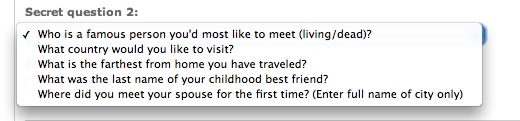
I don’t usually get into nitty-gritty interaction design issues like this on my blog. But I recently moved to a new address, and started new web accounts with various services like phone and utilities. And almost all of them are adding new layers of security asking me additional personal questions that they will use later to verify who I am. And entirely too many are asking questions like these, asked by AT&T on their wireless site:

badsecurity1

I can’t believe how many of them are using “favorites” questions for security. Why? Because it’s so variable over time, and because it’s not a fully discrete category. Now, I know I’m especially deficient in “favorite” aptitude — if you ask me my favorite band, favorite food, favorite city, I’ll mumble something about “well, I like a lot of them, and there are things about some I like more than others, but I really can’t think of just one favorite…” Most people probably have at least something they can name as a favorite. But because it’s such a fuzzy category, it’s still risky and confusing.

It’s especially risky because we change over time. You might say Italian food is your favorite, but you’ve never had Thai. And when you do, you realize it blows Italian food away — and by the next time you try logging into an account a year later, you can’t remember which cuisine you specified.

Even the question about “who was your best friend as a kid” or “what’s the name of your favorite pet, when you were growing up” — our attitudes toward these things are highly variable. In fact, we hardly ever explicitly decide our favorite friend or pet — unless a computer asks us to. Then we find ourselves, in the moment, deciding “ok, I’ll name Rover as my favorite pet” — but a week later you see a picture in a photo album of your childhood cat “Peaches” and on your next login, it’s error-city.

I suspect one reason this bugs me so much is that it’s an indicator of how a binary mentality behind software can do uncomfortable things to us as non-binary human beings. It’s the same problem as Facebook presents when it asks you to select which category your relationship falls into. What if none of them quite fit? Or even if one of them technically fits, it reduces your relationship to that data point, without all the rich context that makes that category matter in your own life.

Probably I’m making too much of it, but at least, PLEASE, can we get the word out in the digital design community that these security questions simply do not work?

Congratulations to Andrea Resmini and all the hardworking, brilliant people who just launched the Journal of Information Architecture.

I’m not saying this just because I’m fortunate enough to have an article in it, either. In fact, I hope my tortured prose can live up to the standard set by the other writers.

Link to contents page for Journal of IA Volume 1, Issue 1

About my article, “The Machineries of Context” [PDF]. In the article, I try explaining why I think Information Architecture is kind of a big deal — how linking and creating semantic structures in digital space is an increasingly challenging, important practice in the greater world of design. In essence, re-framing IA to help us see what it has been all along.

Update: The Information Architecture Institute was kind enough to publish an Italian translation of the article.

Here’s the presentation I did for A Summit 2009 in Memphis, TN. It’s an update of what I did for IDEA 2008; it’s not hugely different, but I think it pulls the ideas together a little better. The PDF is downloadable from SlideShare. The notes are legible only at full-screen or on the PDF.

.
.
.
Now that the workshop has come and gone, I’m here to say that it went swimmingly, if I do blog so myself.

My colleagues did some great work — hopefully it’ll all be up on Slideshare at some point. But here are the slides I contributed. Alas, there are no “speaker notes” with these — but most of the points are pretty clear. I would love to blog about some of the slides sometime soon — but whenever I promise to blog about something, I almost guarantee I won’t get around to it. So I’ll just say “it would be cool if I blogged about this…” :-)

—————–
Just one more blog plug for the workshop some of us are doing before the IA Summit in Memphis this year.

Links:
See the Pre-Con Page at the Conference Site.
Register Here

For those of you who may be attending the IA Summit in Memphis this year, let me encourage you to look into the IA Institute’s pre-conference workshop called “Beyond Findability: Reframing IA Practice & Strategy for Turbulent Times.”

A few things I want to make clear about the session:

– We’re making it relevant for any UX design people, not just those who self-identify as “Information Architects.” In fact, part of the workshop is about how different practitioner communities can better collaborate & complement other approaches.
– By “Turbulent times” we don’t just mean the economy, but the turbulence of technological change — the incredibly rapid evolution of how people use the stuff we make.
– It’s not a how-to/tutorial-style workshop, but meant to spark some challenging conversation and push the evolution of our professions ahead a little faster.
– There will, however, be some practical take-away content that you should be able to stick on a cube wall and make use of immediately.
– It’s not “anti-Findability” — but looks at what IA in particular brings to design *beyond* the conventional understanding of the practice.
– We’re hoping experienced design professionals will attend, not just newer folks; the content is meant to be somewhat high-level and advanced, but you should be able to get value from it no matter where you are in your career.

Here’s the quickie blurb:

This workshop aims to take your IA practice to a higher level of understanding, performance and impact. Learn about contextual models and scalable frameworks, design collaboration tactics, and how to wield more influence at the “strategy table.”

If you have any specific questions about it, please feel free to hit me up with an email!

*Note: the IA Summit itself is produced by ASIS&T, not the IA Institute.

Here’s an excellent article written up at the ASIS&T Bulletin, by some talented and thoughtful folks in Europe (namely Andrea Resmini, Katriina Byström and Dorte Madsen). I’ll quote the end of the piece at length.

IA Growing Roots – Concerning the Journal of IA

Even if someone’s ideas about information architecture are mind-boggling, if they do not discuss them in public, embody them in some communicable artifact and get them to be influential, they are moot. This reality is the main reason behind the upcoming peer-reviewed scientific Journal of Information Architecture, due in Spring 2009. For the discipline to mature, the community needs a corpus, a defining body of knowledge, not a definition.

No doubt this approach may be seen as fuzzy, uncertain and highly controversial in places. Political, even biased. But again, some overlapping and uncertainty and controversy will always be there: Is the Eiffel Tower architecture or engineering? The answer is that it depends on whom you ask, and why you ask. And did the people who built it consider themselves doing architecture, engineering or what? The elephant is a mighty complex animal, as the blind men in the old Indian story can tell you, and when we look closer, things usually get complex.

The IA community does not need to agree on a “definition” because there is more to do. An analytical approach must be taken on the way the community sees itself, with some critical thinking and some historical perspective. The community needs to grow roots. We hope the Journal will help along the way.

I especially like the Eiffel tower example. And putting a stake in the ground saying let’s not worry about a definition, we have more work to do. This is the sort of mature thinking we need at the “discipline” level, where people can focus on the academic, theoretical framework that helps evolve what the bulk of IA folk do at the “practice” level. (Of course, that flow works in the other direction too!)

« Older entries § Newer entries »