Information Architecture

You are currently browsing the archive for the Information Architecture category.

Whenever I say that the Hyperlink changed the world, people look at me like “huh?” The lowly hyperlink is often overlooked as just a ‘feature’ of the Internet or the Web in particular. But I’ve always thought that was a bit backwards. The hyperlink is what made the web possible — it is for the Web what carbon is for carbon-based life-forms.

So I was tickled to find that Alex Wright’s excellent article on The Mundaneum Museum has this gem of a quotation from Kevin Kelly:

“The hyperlink is one of the most underappreciated inventions of the last century,” Mr. Kelly said. “It will go down with radio in the pantheon of great inventions.”

IDEA 2008

idea08 badge

I’d like to encourage everyone to attend IDEA 2008, a conference (organized by the IA Institute) that’s been getting rave reviews from attendees since it started in 2006. It’s described as “A conference on designing complex information spaces of all kinds” — and it’s happening in grand old Chicago, October 7-8, 2008.

Speakers on the roster include people from game design, interaction design and new-generation advertising/marketing, and the list is growing, including (for some reason) my own self. I think I’m going to be talking about how context works in digital spaces … but I have until October, so who knows what it’ll turn into?

IDEA is less about the speakers, though, than the topics they spark, and the intimate setting of a few hundred folks all seeing the same presentations and having plenty of excuses to converse, dialog and generally brou some haha.

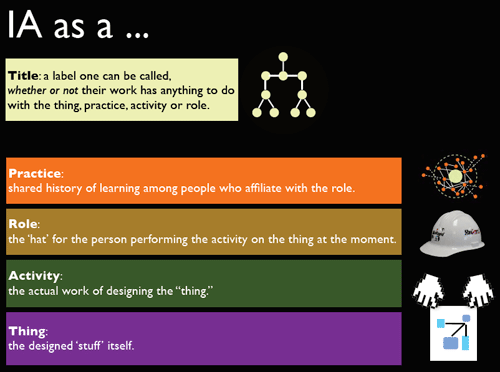
In the closing talk for this year’s IA Summit, I had a slide that explains the various layers that make up what we use the term “Information Architect” (or “Information Architecture”) to denote. I think it’s important to be self-aware about it, because it helps us avoid a lot of wasted breath and miscommunication.

But I also stressed that I don’t think this model is only true of IA. So please, feel free to replace “IA” in the diagram with the name of any practice, profession or domain of work.

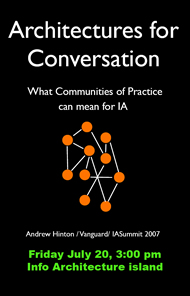
To understand this diagram, especially the part about Practice, it helps to have a basic understanding of what “practice” is and how it emerges from a community that coalesces around a shared concern. The Linkosophy deck gets into that, and my UX as Communities of Practice deck does as well, while getting into more detail about the participation/reification dynamic Wenger describes in his work.

Here’s the model: I’ll do a bit of explanation after the jump.

title and role stack (small version)

Read the rest of this entry »

Linkosophy

In 2008 I had the distinct honor to present the closing plenary for the IA Summit in Miami, FL. Here’s the talk in its entirety. Unfortunately the podcast version was lost, so there’s no audio version, but 99% of what I had to say is in the notes.

NOTE: To make sense of this, you’ll need to read the notes in full-screen mode. (Or download the 6 MB PDF version.)

(Thanks to David Fiorito for compressing it down from its formerly gigantic size!)

Giving this talk at the IA Summit was humbling and a blast; I’m so grateful for the positive response, and the patience with these still-forming ideas.

If you’re after some resources on Communities of Practice and the like, see the post about the previous year’s presentation which has lots of meaty links and references.

Note: This is something I had embedded in a few very long presentations from last year, and I’m realizing it would probably be useful (to me if nobody else) to elaborate on it as its own topic. Here’s the first part.

social equation

There’s a lot of writing and thinking happening around the best approaches to designing platforms for social activity. I certainly haven’t read it all, and it keeps being added to every day. But from what I have read, and from the experiences I’ve had with social design factors, I distilled the basics down to a simple equation. “Cultivation equals Motivation divided by Moderation.” It sounds like a no-brainer, to those of us who’ve been thinking about this stuff for a while. For me, though, it helps keep focus on the three most important elements to consider with any social design undertaking.

Cultivation

Cultivation requires that we recalibrate the approaches we’ve inherited from traditional top-down ideas of social management & design. In other words, it’s cultivation rather than dictation. To ‘cultivate’ something implies that there is an existing culture — some organic, emergent, collective entity — that exists regardless of our intrusion, with its own natural rhythms and patterns.

Communities Happen

How do we help a community maintain its health, value and effectiveness for the individuals involved in it? We certainly don’t start re-defining it and prescribing (or pre-scripting) every process and action. Rather than dictating the content of the culture’s behavior, we create and manage the right conditions for the community to improve itself on its own terms. This is much more like gardening than managing in the traditional sense.

You can’t create a community by fiat. You can’t legislate or force participation — then all you get is a process, not social interaction. Social interaction may take place under the surface, but that’s in spite of your central planning, not because of it. Communities happen in an emergent way, on their own.

Mistaking the Ant-Hill for the Colony

It’s easy to make the mistake of thinking that the software for an online community actually is, in some way, the community itself — that the intentionally designed technology “network” is the social network. But these technological tools are a medium for the thing, not the thing itself. It’s like mistaking the ant hill for the ant colony. We often point at ant hills and say “there’s an ant colony” but the social behaviors of the ants exist whether they happen in that pile of earth or another.

Social software platforms tap into conversations that already exist in some form or another. At best they can enable and amplify those conversations and help them broaden outside of their original confines, even redefine themselves in some way. Of course, many of the connections people make on these platforms may never have happened without the software, but there had to be the propensity for those connections to happen to begin with.

Designing for social activity, then, is about creating infrastructure that helps communities and social patterns behave according to their own natures. Even the social character of the network isn’t created by the software. Rather, the platform’s architecture encourages only certain kinds of extant networking behaviors to thrive.

Take, for instance, LinkedIn vs MySpace. LinkedIn didn’t create the behavior of calm, professional networking interactions, introductions and linking between peers. That kind of behavior was going on long before LinkedIn launched. But its architecture is such that it allows and encourages only that kind of social interaction to take root. MySpace, on the other hand, is much more open architecturally; linking is much more informal, and self-expression is almost completely unfettered. The nature of the MySpace platform, however, essentially guarantees that few will want to use it for the sober, corporate-style networking that happens on LinkedIn. (Lots of professional work goes on in MySpace, of course, but mainly in the creative & performing arts space, where self-expression and unique identity cues are de facto requirements.)

So the character of the platform’s architecture — its rules and structures — determine the character of social behavior that your platform is most likely to attract and support. But once you’ve done that, then how do you cultivate it?

Authenticity

One important factor is something you can’t create artificially: the cultivators have to be invested in the community they’re cultivating. This cannot be faked. There are too many levels of tacit understanding — gut-level feel — necessary for understanding the nuances of a particular culture involved to do otherwise. You have to be willing to get your hands dirty, just like in a garden. Communities are fine with having decisions and rule-creation happening from some top-down component (which we’ll talk about in a minute) but only if they perceive the authority as having an authentic identity within the community, and that any design changes or “improvements” to the platform are coming from shared values.

Example: one reason for Facebook’s public-relations troubles of late is that a number of the design decisions its creator has made have come across as being less about cultivating the community than lining the pockets of investors. Privacy advocates and regular users revolted, and forced Facebook to adjust their course.

Another example: MySpace managed to give new users the impression that the people running the site were just “one of them” by creating the ubiquitous persona of “Tom.” Tom is a real person, one of the co-founders of the platform, who has a profile, and who “welcomes” you to the network when you join. He’s the voice for announcements and such that come from those who created and maintain MySpace. Tom is real, to a point — recently, it was discovered that Tom’s age and information have been tweaked to make him seem more in line with the service’s target demographic. It’s arguable that by the time this disillusioning revelation occurred, MySpace had grown to enough critical mass that it didn’t matter. I suspect, though, that the Tom avatar still serves its purpose for millions of users who either don’t know about the news, or think of him more as the Ronald McDonald of the brand — a friendly face that gives the brand some personality, even if they don’t care if it’s a real person.

If you’re cultivating from an authentic stance, and you understand that your role isn’t dictator, then it’s a matter of executing cultivation by striking the right balance between Motivation and Moderation.

Next up … Motivation & Moderation. Stay tuned.

There’s been a lot of talk over the last couple of years about a collective Eureka moment where we’ve all come to realize that the Internet, the Web, and designing User Experiences for those platforms, is “really about People … not products and information.”

I think it’s great that more folks are coming to this realization.

But in the same breath, some of these folks will then say that Information Architecture is hopelessly out of touch with this reality … that IA is ‘dead’ or that there’s no such thing as an information architecture, since it’s all user-driven nowadays. I’m not going to point to specific instances, because I’m not posting this to start more flame wars … just to finally state something I wish I’d blogged over a year ago.

What these (I’m sure well-meaning) people don’t seem to grasp is that the IA community has been focused on social infrastructures for a very long time. Some of the most successful writing and design has come from members of this practitioner community — witness Epinions, Slideshare, and PublicSquare just to name a few platforms. Members of this community have published books and blogs at the forefront of social design thinking.

In fact, in the much-maligned “Manifesto” the IAI posted back in 2002, there was this language:

* One goal of information architecture is to shape information into an environment that allows users to create, manage and share its very substance in a framework that provides semantic relevance.
* Another goal of information architecture is to shape the environment to enable users to better communicate, collaborate and experience one another.
* The latter goal is more fundamental than the former: information exists only in communities of meaning. Without other people, information no longer has context, and no longer informs.

I’ll take the blame for some of the corny language in that document — but hey, it was a manifesto for crying out loud … a bit of purple prose is par for the course.

The point is, this has always been part of our community’s focus. If people don’t realize that, they’ve not been paying attention.

There. It feels good to get things off one’s chest, no? :-) Ok… carry on.

Kevin Kelly’s article Bottom Up is Not Enough is making the rounds, and rightly so. Here’s a snippet:

Here’s how I sum it up: The bottom-up hive mind will always take us much further than even seems possible. It keeps surprising us in this regard. Given enough time, dumb things can be smarter than we think.

At that same time, the bottom-up hive mind will never take us to our end goal. We are too impatient. So we add design and top down control to get where we want to go.

He does speak to “how” we do that, but the word for me is “recalibrate” — we need to recalibrate the apparatuses we use for managing & governing collective behavior. It’s all about cultivation, not dictation.

I haven’t written here in many weeks, but it’s not because I’m not writing.

Lately, though, my thoughts have been too fractured to coalesce into anything that felt like a real blog post. I’m now realizing, however, that they never will unless I unclog the cognitive drain, as it were.

So, this post, in a sense, will be like a visit from Roto-Rooter ™.

– IA tends to be about how users experience information space through time; one space linking to the next, as opposed to how things are arranged and behave on a page or screen. Only way to do this is semantically (language); physical architecture can actually shape space with objects. IA is about the Z axis. I am here, and *THEN* I am here. Links are about time — they shape it, chop it into discrete experiences, even name it.

– Eno’s idea that all culture is a simulacrum, that it’s all invented bits of identity that we can play in, try out. Shopping, movies, fashion, art, music — all of it. (Also love his idea that “culture is everything you don’t have to do.”

– IA provides simulated places, directions to try. Playfulness encompasses this too — moving into, through, past various options — aggregating into something we retroactively experience as a narrative arc. (But that’s constructed by the user … any arc we try to create artificially just gets in the way of this act of meaning-making by the user. We don’t make meaning, we provide spaces for users to do that).

– Will Wright’s phrase: “Possibility Spaces” — great phrase for thinking about IA.

– Whole buildings have been redesigned to change the way people move through them, to get different effects — more conversations, more efficiency, whatever. Virtual spaces have similar effects. What makes MySpace, LinkedIn and Facebook different are just a few basic design choices, mainly around rules & permissions. It’s not their tab-structure that makes them different, it’s the rules — what I’m seeing as the truly architectural aspect of virtual space structures.

– Categories = walls; choosing one semantic structure over another, by default removes all others from play. You can add more, but you can’t add infinitely, or it becomes structureless. Every choice is to promote one thing over all other things (or all other things not also promoted). Just as putting a wall in a building means you can’t walk that way anymore. So categories function just like rules and permissions.

– Rules & permissions, then, are perhaps the bigger entity — and categories are a species of them? Thinking about that… but, at any rate, they’re definitely architectural in nature, and yet we don’t discuss them that much in IA circles. Others are all over it — Clay Shirky, game designers like Will Wright, Craig Newmark, Jimmy Wales, Zuckerberg, others…

– I think it’s IA even if they don’t call it that.

– RS Wurman coined the term IA but it was about representations — maps — that helped us cognitively grok some external reality.

– Then the Web happened, and the map became the landscape — so now IA is about a thing that describes itself (it has to, because on the web, any attempt to effectively map the digital space becomes part of the digital space itself). It’s like one of his ACCESS guides, but one that you literally enter and walk around in — the city and the guide are the same.

– Maybe I love IA for the same reason I loved creating ‘dungeons’ as a kid playing D&D, and later making interactive structures in MUDs and MOOs? Making ‘possibility spaces’ and seeing what design tweaks result in what kinds of experiences?

– Shirky says “there’s no such thing as IA” because, to him, there can be no single authoritative structure anymore — but then points to examples of rules and labels in things like Delicious that, at least in my view, are definitely IA — they’re just not ‘categorization & organization’ IA — they’re the logic of the space that allows people to make sense of and use Delicious. Plus, even if there is no actual IA, it doesn’t mean we don’t experience or perceive it as such. Zen Buddhists say there is no actual “self” but they still name their kids.

– The idea that we organize around objects — network around them — is very powerful. We don’t even see them much of the time, because they’re so taken for granted — we think the relationship exists in and of itself, but it doesn’t. Or rather, it needs a medium to take hold, to instantiate itself — but the relationship likely wouldn’t have begun without that object to begin with. There’s no there there, without the object. (Teaches us something about IA, no? There’s no link without things to link … but those things don’t exist to one another without the link…)

– Conversations are the basis of all of this work, and have always been. Library Science is founded on centuries of Slow Conversations — so slow because they take place in books, over time, using physical spaces and media. One book or article answers another. It was the only way for people divided by space (and time) to have these conversations — later broadcasting, but that too took a lot of time and material for production. Think of it as a very slow chemical reaction — something that takes many years, like fine wines or something?

– The internet has essentially sped up that chemical reaction, put a burner under the test-tube, and made it so that the previous containers & processes are breaking down somewhat. Conversing, organizing, collaborating — all can take place with almost zero inertia. A sort of Cambrian Explosion.

Ok… that’ll do for now. There’s more in my notes, but this is getting to be crazy long.

Facebook Dystopia

I’m sick of Facebook. The noise and annoyance, the confusing permissions, the beta-intrusions into privacy and the rest are bad enough.

But what really chafes me about it is the Facebook Apps framework. I’m in full agreement with this post about Facebook, except that I’m not going to blame the developers that much.

The developers of FB apps are just doing what developers are going to do when given a system that doesn’t encourage better behavior. Facebook could’ve made the framework much more responsible, so that it enforced some good-neighbor rules. A few tweaks that could’ve made all the difference.

What angers me most about it aren’t persnickety user-experience complaints, but the fact that it’s fouling up the ability to communicate and “play” with friends and colleagues, it’s crossing signals and screwing with expectations. I don’t know if I’m offending someone by declining to play a game with them, because I don’t know if the app tricked the user into accidentally inviting a hundred people to use the app and I’m just one more. I don’t know if I want to use an app or not because so many are so poorly designed, and the system gives me no way to know what users are saying about the app.

Unlike Linked-In, FB cheapens the ties that it helps me make socially, by allowing philistines to use them for these viral shenanigans. They drummed up the hype, led people to believe they’d be millionaires if they just got enough people to sign up for an app, and essentially got out of the way of the stampede.

Joi Ito, back in March, posted from the Game Developers Conference, where he is going to be doing a talk on the topic of “More than MMOs: Let Them Build It. How user-created content has transformed online games into a new web platform.” (Wish I could hear that talk! It’s one of my favorite things-to-obsess-upon, as evidenced in my article for ASIST Bulletin last year.)

Joi arrives at the conference assuming it’ll be attended by people like him — old-school hacker types who cut their teeth on early game code and the community of coding — and finds it’s mostly old-school entertainment-business types who simply don’t get it.

… while there are certain companies and individuals who are bridging the gap between the gaming industry and the Internet, the gaming industry is making the same mistakes that the content guys have been making since the beginning of networked computers. They ALWAYS over-estimate the importance of the content and vastly underestimate the desire of users/people to communicate with each other and share. … The professional content is important and will never go away, but it is becoming more of a platform or substrate on which the users build their own communities, interaction and play.

I wonder if it has something to do with the illusion of control, that as a producer of content one has the power to direct others’ attention, to provide meaning? It’s very hard to make the shift (or leap) from the image of oneself as central to peripheral. It makes the re-framing that everyone’s experiencing around “Web 2.0” feel downright Copernican.

SL redux poster

The lovely people of the IAI have arranged for me to give an abbreviated, Second-Life-friendly version of my presentation tomorrow at 3pm Linden Time (i.e. the time in Second Life), or 6pm Eastern US.

It’s abbreviated by necessity — the presentation has many many slides normally, that I go through quickly, but in Second Life the render times are longer. So no fancy builds and transitions, and fewer images overall. But it’ll be an interesting experiment.

I appreciate the IAI folks’ patience with my anxious dithering on this whole thing!

If you get to see it in Second Life, but then want to check out the full presentation, you can read the notes and see all the slides at SlideShare.

Via Jay Fienberg, via the IAI discussion list, I hear of this excellent post by professor David Silver about a talk Silver did recently on the Web 2.0 meme.

Silver starts out lauding the amazing, communal experience of blogs and mashups of blogs and RSS feeds and other Web 2.0 goodness, and then gets into giving some needed perspective:

then i stepped back and got critical. first, i identified web 2.0 as a marketing meme, one intended to increase hype of and investment in the web (and web consultants) and hinted at its largely consumer rather than communal directions and applications. second, i warned against the presentism implied in web 2.0. today’s web may indeed be more participatory but it is also an outgrowth of past developments like firefly, amazon’s user book reviews, craigslist, and ebay – not to mention older user generated content applications like usenet, listservs, and MUDs. third, i argued against the medium-centricness of the term web 2.0. user generated content can and does exist in other media, of course, including newspapers’ letters to the editor section, talk radio, and viewers voting on reality tv shows. and i ended with my all-time favorite example of user generated content, the suggestion box, which uses slips of paper, pencils, and a box.

I think this is very true, and good stuff to hear. (Even in the peculiar lower-case typing…fun!) Group participation has been growing steadily on the Internet in one form or another for years.

I do think, though, that some tipping point hit in the last few years. Tools for personal expression, simple syndication, a cultural shift in what people expect to be able to do online, and the rise of broadband and mobile web access — the sum has become somehow much greater than its parts.

Still, I think he’s right that the buzzword “Web 2.0” is mainly an excellent vehicle for hype that gets people thinking they need consultants and new books. (Tim O’Reilly is a nice guy, I’m sure, but he’s also a business man and publisher who knows how to get conversations started.)

Silver mentions Feevy, a sort of ‘live blogroll’ tool for blogs — it has an excerpt of the latest post by each person on your blogroll. Neato tool. I may have to try it out!

« Older entries § Newer entries »