Information Architecture

You are currently browsing the archive for the Information Architecture category.

It’s pretty obvious to most people who watch users act and react that they do a lot of what they do based on somewhat primal and/or emotionally driven impulses. And I’m sure there’s a lot of neuroscience stuff out there that explains how this works, but I haven’t encountered any until I read the article Mind Games in last week’s New Yorker.

Here are a couple of salient bits:

The first scenario [in the MRI study] corresponds to the theoretical ideal: investors facing a set of known risks. The second setup was more like the real world: the players knew something about what might happen, but not very much. As the researchers expected, the players’ brains reacted to the two scenarios differently. With less information to go on, the players exhibited substantially more activity in the amygdala and in the orbitofrontal cortex, which is believed to modulate activity in the amygdala. “The brain doesn’t like ambiguous situations,” Camerer said to me. “When it can’t figure out what is happening, the amygdala transmits fear to the orbitofrontal cortex.”

The results of the experiment suggested that when people are confronted with ambiguity their emotions can overpower their reasoning, leading them to reject risky propositions. This raises the intriguing possibility that people who are less fearful than others might make better investors . . .

Today, most economists agree that, left alone, people will act in their own best interest, and that the market will coördinate their actions to produce outcomes beneficial to all.

Neuroeconomics potentially challenges both parts of this argument. If emotional responses often trump reason, there can be no presumption that people act in their own best interest. And if markets reflect the decisions that people make when their limbic structures are particularly active, there is little reason to suppose that market outcomes can’t be improved upon.

Part of the article also describes how the researchers used oxytocin (a hormone generated during pleasurable and intimate activities) via nasal inhalers. I have to quote this too because it’s so fascinating.

Trust plays a key role in many economic transactions, from buying a secondhand car to choosing a college. In the simplest version of the trust game, one player gives some money to another player, who invests it on his behalf and then decides how much to return to him and how much to keep. The more the first player invests, the more he stands to gain, but the more he has to trust the second player. If the players trust each other, both will do well. If they don’t, neither will end up with much money.

Fehr and his collaborators divided a group of student volunteers into two groups. The members of one group were each given six puffs of the nasal spray Syntocinon, which contains oxytocin, a hormone that the brain produces during breast-feeding, sexual intercourse, and other intimate types of social bonding. The members of the other group were given a placebo spray.

Scientists believe that oxytocin is connected to stress reduction, enhanced sociability, and, possibly, falling in love. The researchers hypothesized that oxytocin would make people more trusting, and their results appear to support this claim. Of the twenty-nine students who were given oxytocin, thirteen invested the maximum money allowed, compared with just six out of twenty-nine in the control group. “That’s a pretty remarkable finding,” Camerer told me. “If you asked most economists how they would produce more trust in a game, they would say change the payoffs or get the participants to play the game repeatedly: those are the standard tools. If you said, ‘Try spraying oxytocin in the nostrils,’ they would say, ‘I don’t know what you’re talking about.’ You’re tricking the brain, and it seems to work.”

I wonder what this tells us about the focus we should be placing on the emotional response people have to what we’ve designed? Especially when it comes to systems they use to make important decisions about which they may have anxieties or confusion.

Also, I wonder what this means for information architecture specifically, since so much of our most basic daily work is about reducing semantic ambiguity — to what degree does the user’s emotional context affect their ability to reason through what we’re giving them? And, in a Heisenbergian twist, to what degree does the ambiguity of choice within the designed experience exacerbate the user’s context?

We Live Here

The article I wrote for the August/September 2006 ASIS&T Bulletin is up. Thanks to Stacy Surla and the gang at the Bulletin for helping me get it into shape. I’m pleased to say it’s sharing space with a lot of really excellent writing.

It’s weird to read it now, in a way. It’s a snapshot of where my head was 2-3 months ago, and now I my thoughts about the topic have changed somewhat. Not drastically, but just natural drift (hopefully some evolution?). If I can get my wits about me I’ll write about it here.

Oz-IA 2006

If there’s any chance you can make it to a terrific IA conference in Australia, definitely check out Oz-IA 2006. Dates: Saturday, September 30th & Sunday, October 1st

The industrious Eric Scheid tells me that “We’ve now announced the conference program, and it’s quite exciting – lots of practical sessions, by practitioners, for practitioners. Over the next few weeks we’ll be expanding the detail on each session.”

The New Yorker has a very good article on Wikipedia this week. It acknowledges both the positive and negative aspects of the site. I have to agree that Wikipedia will ever supplant the usefulness of a peer-reviewed traditional publication, but it will serve as a useful foil.

Over breakfast in early May, I asked Cauz for an analogy with which to compare Britannica and Wikipedia. “Wikipedia is to Britannica as ‘American Idol’ is to the Juilliard School,” he e-mailed me the next day. A few days later, Wales also chose a musical metaphor. “Wikipedia is to Britannica as rock and roll is to easy listening,” he suggested. “It may not be as smooth, but it scares the parents and is a lot smarter in the end.” He is right to emphasize the fright factor over accuracy. As was the Encyclopédie, Wikipedia is a combination of manifesto and reference work. Peer review, the mainstream media, and government agencies have landed us in a ditch. Not only are we impatient with the authorities but we are in a mood to talk back.

One point the article makes clear is that Wikipedia is, if defined mainly by writing activity, a community where people discuss things. The talk and discussion pages get more use than the actual articles. And that’s part of what I really love about it. Wikipedia (like the Web in general) records and makes explicit all the tacit conversations that go into collective truthmaking.

Evidently the guy who started Wikipedia with Jimmy Wales, Larry Sanger, is now working on a new project — a hybrid of Wikipedia-like opennness with editorial peer review. Depending on how that’s handled, it could be extremely powerful. And why couldn’t Wikipedia be the breeding ground of what eventually ends up there?

Anyway, the article also makes the point that Encyclopedias have always been challenges to hegemonies …

In its seminal Western incarnation, the encyclopedia had been a dangerous book. The Encyclopédie muscled aside religious institutions and orthodoxies to install human reason at the center of the universe—and, for that muscling, briefly earned the book’s publisher a place in the Bastille. As the historian Robert Darnton pointed out, the entry in the Encyclopédie on cannibalism ends with the cross-reference “See Eucharist.”

It’ll be strange to look at something like Wikipedia one day and think of it as a dusty, traditional way of sharing knowledge. But for now, it’s fun to watch the fight.

Mao Mao Mao

There’s been a lot of buzz over the last week or so about Jaron Lanier’s “DIGITAL MAOISM: The Hazards of the New Online Collectivism”
[http://edge.org/3rd_culture/lanier06/lanier06_index.html] in which he warns of a sort of irrational exuberance about “collective intelligence.”

I found myself taking mental notes as I read it, ticking off what I agreed and disagreed with and why. But then I read Douglas Rushkoff’s response:
http://edge.org/discourse/digital_maoism.html#rushkoff

And I realized he’d already expressed everything in my tick-list, and then some, and better than I would’ve.

Lanier’s essay and all the responses to it at Edge are excellent reading for anyone who thinks deeply about what the Internet means to the social fabric, culture, learning and history.

Just a couple of personal reactions:

I found myself feeling a little mollified reading Lanier’s essay. I already knew what it was about and was ready to find mostly disagreement with his points, but ended up realizing I had been guilty of some of the foolishness he calls us on and agreeing with most of what he says.

But then I thought about what I’ve actually believed on the subject and realized, I don’t think I’ve ever thought or said the collective is superior to the individual. Only that “architectures of participation” allow even more individuals to participate in the marketplace of ideas in ways that they simply couldn’t have before. Lanier runs the risk of equating “collective intelligence” with “collectivism” — which is a bit like equating free-market capitalism with Social Darwinism (itself a misnomer).

His main bugbear is Wikipedia. I agree there’s too much hype and not enough understanding of the realities of Wikipedia’s actual creation, use and relevance. But I think that’ll sort itself out over time. It’s still very new. Wikipedia doesn’t replace (and never will) truly authoritative peer-reviewed-by-experts information sources. Even if people are currently referencing it like it’s the highest authority, over time we’ll all start learning to be more authority-literate and realize what’s ok to reference at Wikipedia and what isn’t (just like War of the Worlds tricked thousands in the earlier days of radio — but you really can’t imagine that happening now, could you?)

One thing Lanier doesn’t seem to realize, though, is that Wikipedia isn’t faceless. Underneath its somewhat anonymous exterior is an underculture of named content creators who discuss, argue, compromise and whatever else in order to make the content that ends up on the site. Within that community, people *do* have recognizable personalities. In the constrained medium of textual threaded forums, some of them manage to be leaders who gain consensus and marshall qualitative improvement. They’re far from anonymous, and the “hive” they’re a part of is much closer to a meritocracy than Lanier seems to think.

Not that Wikipedia’s perfect, and not that it meets the qualifications of conventional “authoritative” information sources. But we’re all figuring out what the new qualifications are for this kind of knowledge-share.

At any rate, his essay is very good and has important stuff we have to consider.

I had a blast presenting Clues to the Future as an IA Institute redux session today via phone, gatherplace.com and campfirenow.com. It was a little awkward, honestly, because I haven’t done a presentation that way before. But people were very accomodating.

And some of them had some very cool suggestions about some relevant articles and such, so I’m sharing a couple of them here.

Rules of Play – The MIT Press

Putting the Fun in Functional: applying game mechanics to functional software

The dedicated people who publish UXmatters have launched their April 2006 Issue, with a focus on covering the Vancouver IA Summit.

There are quite a few thorough summaries and reviews of some of the best parts of the conference. I was honored to be asked to review the Conceptual Comics workshop I attended that Friday.

At the IA Summit this year, there was a lot of talk about whether or not individuals organizing information was still relevant (which is an absurd question on one level, but I suppose it’s important to work through this identity crisis together as a community).

There are some things that a designer’s understanding of context can do with information that a hive mind or a universal standard simply cannot.

It hit me with a thud as I read this interview: A Monumental Discussion with Vincent Scully | Metropolis Magazine.

Scully explains one of the design features of the Vietnam Veterans Memorial in Washington, DC:

The other brilliant move was her determination that the names on the memorial reflect the chronology of their deaths. The authorities wanted very much to make it alphabetical. But I’ve heard people standing in front of that wall, pointing up to a cluster of names, and saying: ‘They were all killed by the same burst.’ The memorial is very close to the sequence of how people died. So it’s the whole story of the war. And in a way, symbolically, it starts out with the first casualty, and then it goes in the depths of the war, where the casualties were massive, and then it goes to the last.

There’s the human story. And there’s how stories get told and resonated with how we shape information. It happens every day, in many contexts much more mundane than this … but all of them are meaningful, all of them change us.

Jonkichi is Joi Ito’s blog about his dealings in World of Warcraft. How someone who does as much as he does still manages to be a guild leader in WoW is beyond me.

But he makes an interesting point in this blog post about the way WoW is designed. It points out that even at the hardware architecture level there is a profound effect on the shape of social interaction (and therefore collaboration, culture, and everything) in the game world. Much like in “real life.”

… this is one of the fatal design problems with World of Warcraft. In Second Life, each island has a server and they try to get people to scatter out across the world. In Second Life it is one world with each region connected. In Warcraft, we have over a hundred servers on various continents and “instances” in areas of each server making many many copies of the same game. This gives you a very very small chance of actually being able to meet people that you know in WoW even though you both play. I realize that it’s a fundamental difference, but from a social perspective the results of this “sharded” system that WoW uses are devastating.

IA Summit 2006 Presentation

I presented on the topic “Clues to the Future” at the 2006 IA Summit.

Here is the link to the presentation, in pdf format with notes. It’s 12.8 MB. https://www.inkblurt.com/media/hinton_iasummit06.pdf

It’s also available at the conference site.

If you download the presentation, could you leave me a comment HERE? Just to satisfy my curiosity. Thanks!

————————————————————–
And, here’s the messy list of stuff I’ve been reading from:

Working “Bibliography” Links:

These are most of the sources for research I did when getting thoughts and ideas together for the presentation. I’ll finalize and categorize the list once the Summit is over.

From here to the CD-ROM list are new links I’m possibly referring to as I work further.

Another blog on MMOGs (one post in Oct questions Castranova’s Norrath GDP calculations — but it’s still a pretty high $450 or so)
This is the original one, which continues to be his casual blog
http://www.walkering.com/walkerings/
This is the new “virtual worlds” focused one:
http://3pointd.com/

Can’t believe I missed this: Jane McGonigal’s AvantGame
http://www.avantgame.com/

A new-media wiki page with a great bibliography
http://wiki.media-culture.org.au/index.php?title=User:Paul_Fitzpatrick

Philip Bell Associate Professor of Cognition & Technology
“learning scientist” / teaching science in internet environments
http://faculty.washington.edu/pbell/
his syllabus on “everyday technologies in youth culture”

Playgrounds of the Self: Christine Rosen
excellent article on how people form identities and evolve/experiment with them over time — and how that now plays out online
http://www.thenewatlantis.com/archive/9/rosen.htm

Click to access EDCI505-Winter2005-syllabus.pdf

Radio Open Source entry on “Living in Game Space” and a lot of great links in a sidebar

Living in Game Space

Alternate Reality: The history of massively multiplayer online games.
http://archive.gamespy.com/amdmmog/week1/

First Monday article: The Impact of Digital Games in Education
http://www.firstmonday.org/issues/issue8_7/xyzgros/index.html

Constance Steinkuehler’s site
http://website.education.wisc.edu/steinkuehler/

Selection of presentations and papers given at the “Com Work” Conference
including one by Richard Bartle, the guy who invented MUD in ’78, as well as Julian Dibbel!
http://game.itu.dk/comwork/itu_program.html

Richard Bartle’s site
http://mud.co.uk/dvw/

A nice discussion of Alexander’s “A City is Not a Tree” and concepts of semi-lattice vs. hierarchy, etc.
http://ming.tv/flemming2.php/__show_day/_w2004-05-23
and Shirkey’s mention of it http://many.corante.com/archives/2004/04/26/a_city_is_not_a_tree.php

Article on the legal / tax implications of virtual bartering & “income”
http://www.legalaffairs.org/issues/January-February-2006/feature_dibbell_janfeb06.msp

Terra Nova — a blog on virtual worlds
http://terranova.blogs.com/

Mostly solid overview of Sherry Turkle’s work on identity (ends up a little judgmental and oversimplified)
http://www.transparencynow.com/turkle.htm
and an interview: http://www.priory.com/ital/turkleeng.htm
and an article: http://www.prospect.org/print/V7/24/turkle-s.html

A Testbed for Evaluating Human Interaction with Ubiquitous Computing
(looks at how Quake and other multiplayer environments tell us things about how people behave in ubiq. computing )
Environmentshttps://www.cs.tcd.ie/Dave.Lewis/files/05a.pdf

The Xerox PARC research landing page (esp embedded collab computing, community knowledge sharing, and game ethnography sections are of interest)
http://www.parc.xerox.com/research/csl/default.html

PlayOn — the PARC blog on game research
http://blogs.parc.com/playon/

The “Serious Games Summit”
http://www.seriousgamessummit.com/home.html

Ludology.org
http://www.ludology.org/

A Ludicrous Discipline?
“The information age has, under our noses, become the gaming age. It appears likely that gaming and its associated notion of play may become a master metaphor for a range of human social relations…”
http://gac.sagepub.com/cgi/content/abstract/1/1/29

Game Culture From the Bottom Up (“Productive Play”)
http://gac.sagepub.com/cgi/content/abstract/1/1/17

The Labor of Fun: How Video Games Blur the Boundaries of Work and Play / Nick Yee
“Using well-known behavior conditioning principles, video games are inherentlywork platforms that train us to become better gameworkers. And thework that is being performed in video games is increasingly similar to the work performed in business corporations. The microcosm of these online games may reveal larger social trends in the blurring boundaries between work and play.”
http://gac.sagepub.com/cgi/content/abstract/1/1/68

Social Impact Games
http://www.socialimpactgames.com/

Game Resources Links (a lot of them are already on this list)
http://www.aaim.org/game_resources.htm

From PlayStation to PC
http://www.technologyreview.com/InfoTech/wtr_12770,294,p1.html

Game Mechanic Wikipedia entry
http://en.wikipedia.org/wiki/Game_mechanic

Communication Technologies as Symbolic Form: Cognitive Transformations Generated by the Internet http://www.questia.com/PM.qst?a=o&se=gglsc&d=5001893777

Internet, Emerging Culture and Design
http://www.apa.udel.edu/apa/archive/newsletters/v97n2/computers/culture.asp

Kierkegaard on the Information Highway
http://www.ieor.berkeley.edu/~goldberg/lecs/kierkegaard.html

Ludicorp (creators of Flickr)
http://www.ludicorp.com/about.php

From Computing Machinery to Interaction Design
http://pcd.stanford.edu/winograd/acm97.html

Wikipedia entry on Ludology
http://en.wikipedia.org/wiki/Ludology

Eternal Gamer – weblog
http://www.eternalgamer.com/play/

Grand Text Auto: Georgia Tech’s blog on Game Studies
http://grandtextauto.gatech.edu/

Games * Design * Art * Culture (blog)
http://www.costik.com/weblog/

Below here, added on the CD-ROM file already

John Seely Brown (homepage and article trove)
http://www.johnseelybrown.com/

Gamasutra
http://www.gamasutra.com/

Nick Yee’s Research on Sociology, etc, of games
http://www.nickyee.com/

Nick Yee’s “Project Daedalus” on “The Psychology of MMPORGs”
http://www.nickyee.com/daedalus/

Institute of Computer Science of the Foundation for Research and Technology – Hellas (FORTH)
http://www.ics.forth.gr/hci/activities_outcomes.html

Jeff Dyck Homepage
http://hci.usask.ca/people/jeff/index.shtml

Interaction Lab: University of Saskatchewan: Publications
http://hci.usask.ca/publications/??.xml

Learning from Games: HCI Design Innovations in Entertainment Software (pdf)

Click to access games-gi03.pdf

Building and Experiencing Community in Internet-Based Multiplayer Computer Games (Whitepaper)
http://industries.bnet.com/whitepaper.aspx?scname=Software+and+Games&docid=128802

On Integrating First Person Shooter Games and Ubiquitous Environments (Paper)
Find it here

Game Research site
http://www.game-research.com/

Hybrid Worlds: Social Cyberspace, Imagination and Identity
http://www.dlese.org/cms/qdl/jcdl05/11_Shumar/document_view

Changing Technologies, Changing Literacy Communities?
http://llt.msu.edu/vol4num2/murray/

Digital Games Research Conference 2003 — Presentations
http://www.gamesconference.org/digra2003/2003/index.php

DiGRA Games Conference 2005 Papers
http://www.gamesconference.org/digra2005/papers.php

DiGRA Site

Home

Academic Gamers
http://www.academic-gamers.org/

Marketing to Teens (not complete article)
http://www.emarketer.com/eStatDatabase/ArticlePreview.aspx?1003750

Games & Culture: A Journal of Interactive Media (New journal — excellent resource)
http://gac.sagepub.com/content/vol1/issue1/

Pew Internet & American Life Project Report: Pew Internet: Teens and Technology
(See also all the work at pewinternet.org)
http://www.pewinternet.org/report_display.asp?r=162

Microsoft Research Gives Glimpse of the Future (article)
http://www.pcmag.com/article2/0,1895,1033970,00.asp

Microsoft Social Computing Group
http://research.microsoft.com/scg/

Wallop
http://mywallop.com/

The Coming Age of Calm Technology
http://www.ubiq.com/hypertext/weiser/acmfuture2endnote.htm

Mourning Asheron’s Call
http://crystaltips.typepad.com/wonderland/2005/08/asherons_call_2.html

Business Whitepapers, etc.
http://industries.bnet.com/ENTERTAINMENT+and+LEISURE/Video+Games/Software+and+Games/

Information Technology and the Institution of Identity (paper)
http://www.emeraldinsight.com/Insight/ViewContentServlet?Filename=Published/EmeraldFullTextArticle/Articles/1610110406.html

Here is the proposal final version.

Proposal/Description

Clues to the Future: What the users of tomorrow are teaching us today.

What might Wikipedia have in common with World of Warcraft? And how might that affect design and business strategy today?

According recent academic and business research, there is an enormous wave of people on its way to adulthood that may very well take us by surprise. And while many designers may be aware of this, we still face the challenge of making it clear to our clients and stake-holders.

Beyond the hype and more obvious implications of the “net generation” are key questions that affect how business and design plan for the future. For example: the shift from hierarchical to nodal paradigms; the rise of new kinds of literacy (and authority); the blurring boundaries between ‘virtual’ and ‘real’ economies; the splintering of identity; and users who, frankly, expect your web environment to be as well designed as the best games on their X-Boxes.

It’s important not to focus on the surface gadgetry, but to understand what is different about how these users think, how they solve problems and manage resources, how they socialize and organize, and how vastly different it may be from the assumed conventions of most business and design decision-makers (i.e. people born before 1985).

This presentation will:

1. Survey some of the current research and insights on the issue;
2. Explore some of the more challenging theoretical questions raised;
3. Discuss the practical business and design implications of those questions; and
4. Suggest how those implications might help make stronger cases for innovative design.

Ok, I finally got all the notes fixed up in the Clues to the Future presentation. It’s downloadable from here:

https://www.inkblurt.com/media/hinton_iasummit06.pdf (12.8 MB)

If you download it, please leave a “hello” here in the comments? I’m just curious!

And as always, tons of links and references are on the main page about the presentation, here.

Technorati Tags: ; ;

In the age-old struggle to define Information Architecture, many have insisted that it’s important to separate the role from the tasks, or even the role from the “title” of “Information Architect.” I strongly agree.

But as I thought about it more, I realized there was more definition necessary. We need to figure out how these things like methodologies, responsibilities, roles, titles and disciplines all actually relate to one another, so we’re all walking around on the same cognitive map.

So, in the interest of clarity, I’m proposing a model of sorts for the “what we do” part of Information Architecture.

I’ll describe the model, then discuss how it may illustrate what is really going on in our collective yearning to define (or not) IA.

Here’s a figure — please see the description below.
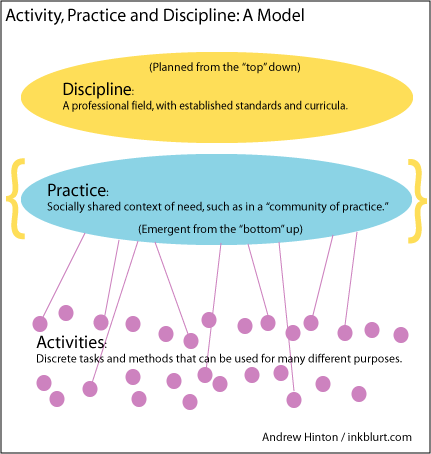
ialayers448

Here I am separating out “Activity” and “Practice” and “Discipline” in the same way that it’s broken down in the “25 Theses“:

23. Information architecture acknowledges that this practice is bigger than any single methodology, tool or perspective.
24. Information architecture is first an act, then a practice, then a discipline.
25. Sharing the practice grows the discipline, and makes it stronger.

Activities

By “act” I refer to the methodologies, tools, whatever. These are all acts, or in this model, they are “activities.”

Activities are agnostic. They aren’t necessarily related to any particular discipline or even any particular practice. Just as a hand saw isn’t only for housebuilding — it can be used for all kinds of other woodwork.

Let’s take a common task used by IAs: Card Sorting. Card sorting was invented at some point by someone so that they could better understand how people organized categories and labels. It’s not an inherently “Information Architecture” activity any more than the screwdriver is an “auto repair” tool.

“But surely,” you may say, “a saw is always a tool for cutting wood! It’s not useful for, say, nailing things.” Absolutely. There is always some boundary around the usefulness of any tool (i.e. activity). Let’s say, then, that in this analogy, the saw is like card sorting, and all of woodwork is equivalent to “design.” Saws get used in all sorts of places within woodwork. It’s very important both to the housebuilder and the shipbuilder, for instance. Someone who does both relates it to whichever one happens to be the current context of need.

Keep this in mind: “Context of Need.” The tool was certainly invented for some context, but it’s often useful in many other contexts. The context of need becomes important for what we mean by “Practice.”

An important point: just because a particular discipline or practice (we’ll define them shortly) happened to *invent* a particular activity, that doesn’t mean that the activity is forever and always inherently defined by that discipline or practice.

Caveat: I’m going to keep running with this saw, carpentry metaphor, and I’m going to do it in a very simplistic parable-like sort of way. Just know that I’m aware I’m probably getting the anthropological history or whatnot completely wrong, and go along with the fun ok?
[Edited to add: I’m not trying to draw an exact analogy between housebuilding and IA — I realize now that it may sound that way. It’s just a simplified example of how tool use and practice and discipline relate to one another. I *do* think that IA and traditional architecture are very similar in abstract … but that’s not the point I was trying to make with this analogy.] Thanks!

Practice

A Practice is essentially a pattern of use. As people coalesce around a shared context of need — shared goals and situational problems to solve — they share ideas and methods and tools.

Long ago when someone wanted to stop living in caves, she decided “hey, that tree over there might make a nice shelter, if I could cut it down and make it into one!” So she figured out a way to do that, and started cutting down trees and shaping the wood, figuring it out as she went. Others who were making their own shelters figured out newer or better tools and methods for cutting the tree down, removing bark, tying them together. They shared these tools and methods, improved them, taught them.

A practice is emerges bottom-up: individuals working as a collective group discover that they have similar contexts of need (a shelter) and, being social organisms, share their expertise and labor.

Community of Practice (CoP) was coined and seminally described by Jean Lave and Etienne Wenger (see Wikipedia article; see historical description). These aren’t created explicitly by any governing body or expert or guru. They just happen, because people want to learn and socially connect based on their particular context of need — their work or hobby or whatever. There is a great deal to learn about the “communities of practice” as an idea in knowledge management, learning studies, etc, but I’m not going to get into that here (but if you haven’t read about it, you should … it’s terrific stuff and I think essential for any IA).

To bring us back to our saw, then … eventually people who were making stuff with wood developed even more sophisticated tools. They relied, in fact, on whole other communities of practice — such as metal workers. It took a blacksmith to create a workable saw (Hopefully the first carpenter to use a saw for carpentry didn’t suddenly declare blacksmithing “dead.” Because that would have been, of course, absurd.)

At any rate, the saw was a pretty sophisticated tool. But it still wasn’t exclusively a “house building” tool, it was used for ship building and other stuff too. However, the community of practice around house building enabled house builders to teach one another the best ways of using the tool — what sorts of wood could take what sorts of saws, what sort of tooth pattern was best for what grain, etc. Many of these issues are peculiar to house building and required tacit and explicit knowledge to be shared about the nuances of saw use for those very particular contexts — different nuances than are required in making ships and other wooden things. The expertise became important enough that people were willing to pay those who were really good at making houses to make houses for them as customers!

At this point, it became a Profession.

Note that in this situation the Profession did not require a Discipline. Professions can be just as loosey-goosey and bottom-up as communities of practice. They don’t necessarily have to have any authority to define them outside of the collective understanding of a given society that a bunch of people make money for working in a generally similar Context of Need.

Another interesting thing about a Community of Practice is that there is no necessary or completely authoritative role or structure. That isn’t to say that there is *no* authority and *no* structure! Usually some structure is necessary just so people can meet (“Let’s meet at the pub on Tuesdays and talk about housebuilding!” or even “Hey when we meet at the pub what you say we focus on building decks this week?”) In terms of authority, there is typically an informal pecking order, a meritocracy of sorts, where people tend to acknowledge who is an expert in what. Certain people have been at it longer, or have more charisma, or are simply louder. These things may even be written down and talked about explicitly. But at heart, they’re tacit and fluid within the community.

Before I get to the “Discipline” portion, let me go ahead and say: I think that we — meaning those who call themselves “people who do a lot of stuff we collectively refer to as information architecture” –are (as a whole) hovering in the blue “Practice” area, or even just below it. That is, we have found one another, and we’re sharing tools and methods for very similar purposes and contexts of need. Some of us are more focused on the Activities (seeing IA as “expert saw usage” as opposed to housebuilding) than on the larger Practice, but most of our leadership seems to understand that there is *some* common and shared Context of Need which drives us, making the sum of all our Activities larger than its the parts.

And for us, it’s especially tricky, partly due to the nature of digital information and the incredible rapidity of change, our contexts are shifting and evolving quickly under our feet. Whereas the carpenters of old had solid wood to deal with that didn’t change from one generation to the next, we’re dealing with stuff that isn’t physical, that’s full of semantic quirkiness, in a technological context that has new inventions and innovations every day. It’s making it especially hard for us to even *describe* where the boundaries are for our community of practice, much less *define* any boundaries. (This distinction between description and definition is important for the next layer — the Discipline.)

Discipline

A Discipline is not bottom-up but top-down. Whereas a community of practice is very horizontal and peer-to-peer, with some informally acknowledged variations in authority and structure, a discipline’s very purpose is to create centralized authority of some kind.

Why make a discipline? I’d say it’s mainly for things like legitimacy and authority in the larger world.

Eventually our housebuilders (saws and other tools in hand!) realized that some housebuilders were competing with them who weren’t qualified, and were making their profession look bad. Or for that matter, when they’d try to collaborate on projects, they were making things so differently that they couldn’t fit walls and joists together well. To keep their profession from losing its integrity, they decided they should figure out who the responsible and capable housebuilders were and tell everybody “here’s the list of housebuilders whom you can trust.” That’s licensing. They also figured out some standards for how to make stuff so it would work together better.

But to do this, they had to agree to a top-down structure of explicit rules and regulations. The trade-off was significant, though. It helped business, and it helped their community of practice by establishing norms and standards, which developed into best practices and “standard stuff you should know,” i.e. curricula for training.

Therefore, the Discipline does not merely *describe* what the Practice is doing. It *defines* what the Practice *should* be doing. (As denoted in the visual model by the brackets around the Practice.)

So, does that mean that once you have a Discipline, the Practice isn’t necessary? Does one destroy the other? Absolutely not. While they may have different, even opposite, qualities, they can often work to be very complementary to one another. In fact, disciplines that really thrive and grow are highly responsive to their communities of practice.

Medicine was a Practice before it was a Discipline. But it was a Discipline for a very long time — its standards have been defined for long stretches of time without being fundamentally changed. It was a Discipline even before germ theory hit the scene, and it resisted germ theory at first! But that discovery changed everything in medical science, and radically shifted what medicine was about. Some say genetic science may do the same thing again.

There is certainly tension. Even the healthiest Discipline/Practice relationships have friction, because by definition a standard is static and resists change long enough to be useful, and agreed upon over time. Communities of practice thrive on the fluidity and collective tacit intelligence of their members, while Disciplines refer to explicit, documented “known truths.” This is an oversimplification, but it describes where they are on the continuum.

This part is important: The Activities are agnostic — they don’t care about context as long as they’re useful in whatever context they’re employed in.

The Practice, however, is *very* concerned with context. It doesn’t exist because of the Activities (the tools and methods), but because of the Context of Need.

Therefore, to describe any Practice, one must articulate the Context of Need that brought it into being, that made it necessary enough for people to coalesce and share their expertise.

For housebuilders, they can point to shelters and say “we needed shelters, so we made these things called houses, and we started getting really good at it by working together and sharing our expertise.”

The Discipline is another layer that doesn’t merely *describe* what has already come into shape — it *defines* what is authoritative, what is standard, what is legitimate.

So what does this mean for Information Architecture?

I think we’re currently in the awkward growing pains of a Community of Practice that yearns for more legitimacy, more resources, more authority and definition. As individuals, we want these things in widely varying degrees. But collectively, it’s impossible to deny that this Community of Practice wants more.

At the same time, we’re a prickly bunch. We didn’t get into what we do because we like other people to label things *for us!* We like to do it ourselves, and make lots of tidy semantic sense out of it.

We aren’t going to get anywhere further unless we can separate the Activities from the Practice. That means coming to some agreed description of our Practice. And that means *agreeing on a shared Context of Need.*

Here’s another very important point: We cannot agree on a DEFINITION until we at least have some agreement on a DESCRIPTION.

And we cannot have a Discipline unless we can agree on definition (which, as just stated, depends on having a description to begin with.)

In addition: We need to stop getting confused between Profession, Discipline, Practice and Activity. Just because we’re getting paid to do something doesn’t mean that defines the Practice or a Discipline. For that matter, just because there are some University majors and courses with “Information Architecture” listed in their titles, it doesn’t mean that we’re any closer to having a real, defined Discipline. It just means that our Community of Practice is becoming more “professional.”

So why can’t we just do that?

Several reasons I can think of (and there are certainly more):

1. We can’t seem to agree on our Context of Need. (I’ll get to this one in a bit.)

2. Unlike our friendly housebuilders, we can’t point at a shelter and say “we make that!” We don’t make things with walls, we make things with relevance. If we do our job well, it’s invisible. It’s very hard to prove a negative, or describe a Discipline with one. This is a serious challenge that we have to tackle. We have to figure out how to point at what we’ve done and say “We made that” — because right now when we do that, interaction designers and usability folks say “um, hey, you’re pointing at an interface.”

3. There are tensions, mostly healthy ones I think, between the bottom-upness of our Practice and the top-downness of the Definition/Discipline that we’re collectively looking for. These should improve with time … conventions and shared understanding will eventually happen. These things cannot be rushed or forced artificially. They can be helped along, though, I would imagine.

As I said, there are probably other reasons.

I’m not saying that all Communities of Practice *have* to eventually become Disciplines. Hip Hop artists are doing quite well, thank you, without getting an MFA in hip-hop. Though I’m sure that’s not far off.

But I am saying that it will be hard for our Community of Practice to evolve further without being able to agree on our description — which hinges on our Context of Need.

And it will be *impossible* to have a Discipline without it.

So what is our Context of Need then?

It may seem obvious, but evidently there’s a lot of disagreement.

Until this point, the model I’ve proposed is pretty neutral. The model, I think, works pretty well regardless of the Practice referenced.

But for Information Architecture, there’s talk that our Context of Need is “wherever some information needs to be organized” and I think that’s dangerous, if we want to have a Discipline, and earn consistent legitimacy and authority in the wider world.

My Contention on the IA Context of Need

Information Architecture happened because of something extraordinary — the Web. I know lots of people say “oh we’ve been doing IA for a long time before the Web,” but my contention is NO. We have not.

What people were doing before the Web was a set of Activities that were applied in other Contexts of Need, as represented by Disciplines and Practices that were already around: Library Science, Architecture, Interior Design, Anthropology, HCI, Graphic Design, Brand Management, Copywriting, etc.

But then the Web happened. Hyperlinks became no longer a specialized concept in computer labs and musty research networks. They became available to everyone who had access to the Web, and access exploded.* Soon after, anybody on the Web was able to not only find and read things there, they were able to create things there themselves. (see Sidebar below on the importance of write-access)

The Web is the ultimate “shared information environment” — and I don’t mean a shared environment *of* information. I mean a shared environment *made of* information — the bricks and mortar are semantics and relevance. This is a key distinction.

Why weren’t people getting together for the stuff we now call IA before the Web? Yeah there were LIS people and the rest, but they already had organizations and practices and context of need of their own.

Something about the Web created a Context of Need that was new. Designers, scientists, writers … bunches of them realized there was something *else* going on that their previous activities and contexts hadn’t quite prepared them for. They realized they would have to adapt their expertise to meet this new context. Probably most people who now call themselves IAs (or their work IA-related work) had this epiphany at some point — they started out doing other things, but felt a need to adapt and evolve their work to meet a new context. That’s why they sought each other out and came up with mailing lists and discussion boards to begin with.

It just so happens that the book that appropriated the term Information Architecture for this new Practice (to deal with the new Context of Need) was written by LIS folks. And so, of course, it is written from that perspective. If the first major book to attend to the new Context of Need had been written by programmers or graphic designers, it would’ve been heavily slanted toward *their* tools and activities.

Over time, though, we’ve realized that, partly because the Web is so all-encompassing and mashes up so many parts of human experience, many other Disciplines and Practices have elements that can be appropriated and adapted for the Web Context of Need as well as LIS.

In fact, we need all those Disciplines and Practices to keep right on being experts in what they do, because their innovations are often helpful for us.

But guess what? It turns out they need the IA Practice to do the same thing.

At some point I want to write further about why I think it’s important that we not confuse Information Architecture with non-digital environment design, but I won’t belabor it right now.

I just want to make this clear: we need to focus our description of what we do, and the value we bring. We need to come to some shared understanding on what Context of Need we *primarily* address. Without that focus, we allow Information Architecture to continue to be viewed by many people as just a fancy name for stuff that other Disciplines and Practices already do. We don’t do ourselves any favors by trying to define ourselves with contexts of need that other practices and disciplines already cover quite nicely on their own (even if they don’t always do it well). Just because another Context of Need can be helped by some excellent taxonomy and card sorting work, it doesn’t necessarily mean IA is the best Practice for the job.

I hope this model, and my ruminations, can maybe help build toward a little more clarity. Or at least a language we can use to move things along a little more.

* Sidebar: The importance of write-access: All Web 2.0 really is, in my opinion, is the rise of write-access. For the first chunk of time, even though the Web was growing fast, it was mainly useful as a place for information retrieval because most people couldn’t *write* to it, only read from it. And even where they could write to it, most people hadn’t had it around long enough to mentally switch from a broadcast mindset to a peer-to-peer mindset… we were all trained to be broadcast to, or to find and read and use things other people made.

While information retrieval is still exceedingly important, the infrastructure has blown the doors off of write-access, turning the Web into the Peer to Peer network that it was invented to be. The scientists who wanted to use it to begin with all had write access. It just took a number of years for the infrastructure to mature enough that non-experts could write to it as well, and a few years more for it to sink in that “holy crap I can make stuff here too!”

Web 2.0 is just a rediscovery of what the Web was about to begin with: social, peer to peer communication. Whether it’s about science or comic books or sex or buying stuff — it’s all conversation. It’s all social interaction. Information retrieval and search are just tools we use as part of the whole.

« Older entries § Newer entries »