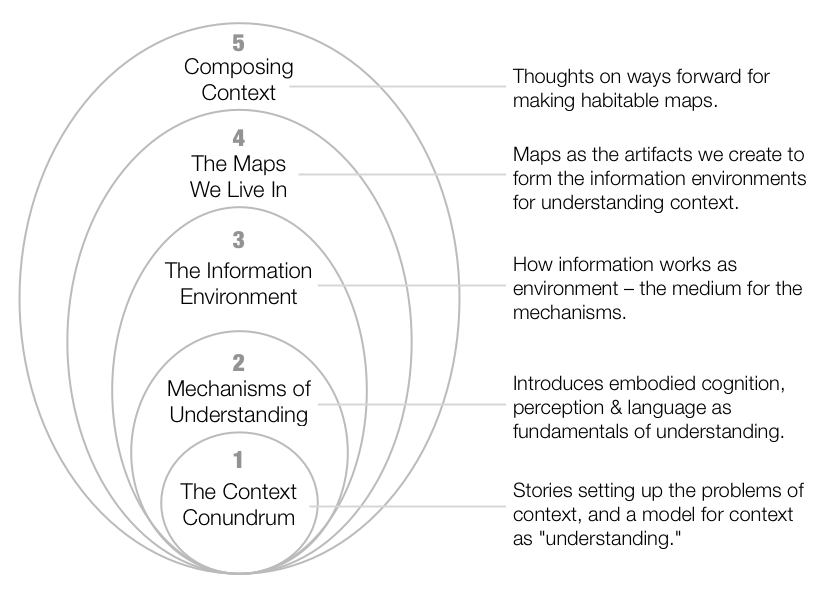
In the closing talk for this year’s IA Summit, I had a slide that explains the various layers that make up what we use the term “Information Architect” (or “Information Architecture”) to denote. I think it’s important to be self-aware about it, because it helps us avoid a lot of wasted breath and miscommunication.
But I also stressed that I don’t think this model is only true of IA. So please, feel free to replace “IA” in the diagram with the name of any practice, profession or domain of work.
To understand this diagram, especially the part about Practice, it helps to have a basic understanding of what “practice” is and how it emerges from a community that coalesces around a shared concern. The Linkosophy deck gets into that, and my UX as Communities of Practice deck does as well, while getting into more detail about the participation/reification dynamic Wenger describes in his work.
Here’s the model: I’ll do a bit of explanation after the jump.

[Read more →]
Share:
These icons link to social bookmarking sites where readers can share and discover new web pages.
Tags:communities of practice·Information Architecture·profession·ux·wenger
The granddaddy of the Internet clarifies a popular misconception.
Print What I’ve Learned: Vint Cerf
Al Gore had seen what happened with the National Interstate and Defense Highways Act of 1956, which his father introduced as a military bill. It was very powerful. Housing went up, suburban boom happened, everybody became mobile. Al was attuned to the power of networking much more than any of his elective colleagues. His initiatives led directly to the commercialization of the Internet. So he really does deserve credit.
Something tells me you won’t hear this quoted on Fox News. (Or from hardly anyone else, probably.)
Share:
These icons link to social bookmarking sites where readers can share and discover new web pages.
Tags:History·internet·vint cerf
April 16th, 2008 · 4 Comments ·
In the “Linkosophy” talk I gave on Monday, I suggested that a helpful distinction between the practices of IxD & IA might be that IxD’s central concern is within a given context (a screen, device, room, etc) while IA’s central concern is how to connect contexts, and even which contexts are necessary to begin with (though that last bit is likely more a research/meta concern that all UX practices deal with).
But one nagging question on a lot of people’s minds seems to be “where did these come from? haven’t we been doing all this already but with older technology?”
I think we have, and we haven’t.
Both of these practices build on earlier knowledge & techniques that emerged from practices that came before. Card sorting & mental models were around before the IA community coalesced around the challenges of infospace, and people were designing devices & industrial products with their users’ interactions in mind long before anybody was in a community that called itself “Interaction Designers.” That is, there were many techniques, methods, tools and principles already in the world from earlier practice … but what happened that sparked the emergence of these newer practice identities?
The key catalyst for both, it seems to me, was the advent of digital simulation.
For IA, the digital simulation is networked “spaces” … infospace that’s made of bits and not atoms, where people cognitively experience one context’s connection to another as moving through space, even though it’s not physical. We had information, and we had physical architecture, but they weren’t the same thing … the Web (and all web-like things) changed that.
For IxD, the digital simulation is with devices. Before digital simulation, devices were just devices — anything from a deck chair to an umbrella, or a power drill to a jackhammer, were three-dimensional, real industrially made products that had real switches, real handles, real feedback. We didn’t think of them as “interactive” or having “interfaces” — because three-dimensional reality is *always* interactive, and it needs no “interface” to translate human action into non-physical effects. Designing these things is “Industrial Design” — and it’s been around for quite a while (though, frankly, only a couple of generations).
The original folks who quite consciously organized around the collective banner of “interaction designer” are digital-technology-centric designers. Not to say that they’ve never worked on anything else … but they’re leaders in that practitioner community.
Now, this is just a comment on origins … I’m not saying they’re necessarily stuck there.
But, with the digital-simulation layer soaking into everything around us, is it really so limiting to say that’s the origin and the primary milieu for these practices?
Of course, I’m not trying to build silos here — only clarify for collective self-awareness purposes. It’s helpful, I believe, to have shared understanding of the stories that make up the “history of learning and making” that forms our practices. It helps us have healthier conversations as we go forward.
Share:
These icons link to social bookmarking sites where readers can share and discover new web pages.
Tags:communities of practice·IA·Information Architecture·Interaction Design·IxD
April 15th, 2008 · 4 Comments ·
I finally uploaded Linkosophy on SlideShare.
Or you can download the 6 MB PDF version.
(Thanks to David Fiorito for compressing it down from its formerly gigantic size!)
Giving this talk at the IA Summit was a blast; I’m so grateful for the positive response, and the patience with these still-forming ideas.
If you’re after some resources on Communities of Practice and the like, see the post about the previous year’s presentation which has lots of meaty links and references.
I’m looking forward to seeing where the conversation goes from here!
NOTE: You need to view this in “Full Screen” mode, which you can only do from the SlideShare page itself. Otherwise, the narrative text isn’t readable.
Share:
These icons link to social bookmarking sites where readers can share and discover new web pages.
Tags:communities of practice·Design·iasummit2008·Information Architecture
April 13th, 2008 · 5 Comments ·
So, only a few days after I posted the original version of this, I’m doing an about-face.
I was keeping my feed locked, because Twitter is such an informal, impulsive broadcasting platform, that I like knowing only a small circle will see my brainfarts.
Keeping it locked, however, means that anyone I “allow” to see my Tweets is added to my own feed (and I have no choice in this). And I already have too many Twitterers to keep up with as it is.
But a lot of really wonderful people are wanting to add me and see those brainfarts. Why, I do not know. But it seems downright rude to lock them out.
So I’m going to try to keep it open for a while and see how that goes.
Disclaimers
- Please don’t be offended if I don’t follow you back, or if I stop following for a while and then start again, or whatever. I’d expect you to do the same to me. All of you are terribly interesting and awesome people, but I have limited attention.
- Please don’t assume I’ll ever actually see it if you “@” message me. (I don’t assume it when I do it either.)
- Direct-messages are fine, but emails are even better and more reliable for most things (imho).
-
If you’re twittering more than 10 tweets a day, I may have to stop following just so I can keep up with other folks.
- If you add my feed, I will certainly check to see who you are, but if there’s zero identifying information on your profile, why would I add you back?
A Few Guidelines for Myself that I Kind-of Sort-of Expect from Others
- I’ll try to keep tweets to about 10 or less a day, at most, to avoid clogging my friends’ feeds.
- I’ll try to avoid doing scads of “@” replies, since Twitter isn’t a great conversation mechanism, but is pretty ok as an occasional comment-on-a-tweet mechanism.
- I’ll avoid doing long-form commentary or “live-blogging” using Twitter, since it’s not a great platform for that (RSS feed readers give the user the choice to read each post; Twitter feed readers do not, and allow over-tweeting to crowd out other voices on my friends’ feeds.)
- I’ll post links to things only now and then, since I know Twitter is very often used in (and was intended for) mobile contexts; and when I do, I’ll give some context, rather than just “this is cool …”
- In spite of my best intentions, I’ll probably break these guidelines now and then, but hopefully not too much, whatever “too much” is.
Thanks for indulging my curmudgeonly Twitter diatribe. Good day.
Share:
These icons link to social bookmarking sites where readers can share and discover new web pages.
Tags:socialsoftware·Twitter
The IA Summit is going fine so far. Miami is delightful.
I set up a channel on Freenode so that if anybody wants to get their chat on during sessions, we can do it there.
For those of you who just want to chat without much muss or fuss, go here: http://java.freenode.net//index.php?channel=iasummit2008 … and BE SURE to enter a username for yourself (so everybody isn’t called “Traveler”!!).
Wait for the java applet to load, and you’re all set.
For those of you who know how to use an IRC client, just use network irc.freenode.net and join the channel #iasummit2008.
Also, if any of you are somewhat familiar with IRC and how to moderate a channel, I’d love to add you as a moderator, so please ping me at inkblurt@gmail.com or direct msg me on twitter (at “inkblurt”). I’m not going to be in there all the time (and maybe even not that much), but I did register the channel so that it’ll stay up and remember its moderators for the rest of the weekend, at least.
To keep op status, btw, you will have to register with ChanServ on that server (I think).
Share:
These icons link to social bookmarking sites where readers can share and discover new web pages.
Tags:iasummit2008·Information Architecture
March 19th, 2008 · 2 Comments ·
Since so much of our culture is digitized now, we can grab clippings of it and spread it all over our identities the way we used to decorate our notebooks with stickers in grade school. Movies, music, books, periodicals, friends, and everything else. Everything that has a digital referent or avatar in the pervasive digital layer of our lives is game for this appropriation.
I just ran across a short post on honesty in playlists.
The what-I’m-listening-to thing always strikes me as aspirational rather than documentary. It’s really not “what I’m listening to” but rather “what I would be listening to if I were actually as cool as I want you to think I am.”
And my first thought was: but where, in any other part of our lives, are we that “honest”?
Don’t we all tweak our appearances in many ways — both conscious and unconscious — to improve the image we present to the world? Granted, some of us do it more than others. But everybody does it. Even people who say they’re *not* like this actually are … to choose to be style-free is a statement just as strong as being style-conscious, because it’s done in a social context too, either to impress your other style-free, logo-hating friends, or to define yourself over-against the pop-culture mainstream.
Now, of course it would be dishonest to list favorite movies and books and music that you neither consume nor even really like. But my guess is a very small minority do that.
Our decorations have always been aspirational. Always. From idealizing the hunt with wall cave wall drawings to hanging pictures of beautiful still-life scenes of stuff you can’t afford in middle-class homes in the Renaissance, all the way to choosing which books to put on the eye-level shelves in your apartment, or making a cool playlist of music for a party. We never expose *everything* in our lives, we always select subsets that tell others particular things about us.
The digital world isn’t going to be any different.
(See earlier post on Flourishing.)
Share:
These icons link to social bookmarking sites where readers can share and discover new web pages.
Tags:flourishing socialsoftware

Share:
These icons link to social bookmarking sites where readers can share and discover new web pages.
Tags:gygax games d&d death

Some very nice and well-meaning people have asked me to speak as the closing plenary at the IASummit conference this year, in Miami.
This is, as anyone who has been asked to do such a thing will tell you, a mixed blessing.
But I’m slogging through my insanely huge bucket of random thoughts from the last twelve months to surface the stuff that will, I dearly hope, be of interest and value to the crowd. Or, at the very least, keep their hungover cranial contents entertained long enough to stick around for Five-Minute Madness.
“Linkosophy” is a homely title. But it’s a hell of a lot catchier than “Information Architecture’s Role in the UX Context: What Got It Here, What It’s About, and Where It Might Be Headed.” Or some such claptrap.
Here’s the description and a link:
Closing Plenary: Linkosophy
Monday April 14 2008, 3:00 - 4:00PM
At times, especially in comparison to the industrial and academic disciplines of previous generations, the User Experience family of practices can feel terribly disorganized: so little clarity on roles and responsibilities, so much dithering over semantics and orthodoxy. And in the midst of all this, IA has struggled to explain itself as a practice and a domain of expertise.
But guess what? It turns out all of this is perfectly natural.
To explain why, we’ll use IA as an example to learn about how communities of practice work and why they come to be. Then we’ll dig deeper into describing the “domain” of Information Architecture, and explore the exciting implications for the future of this practice and its role within the bigger picture of User Experience Design.
In addition, I’ve been dragooned (but in a nice way … I just like saying “dragooned”) to participate in a panel about “Presence, identity, and attention in social web architecture” along with Christian Crumlish, Christina Wodtke, and Gene Smith, three people who know a heck of a lot more about this than I do. Normally when people ask me to talk about this topic, I crib stuff from slides those three have already written! Now I have to come up with my own junk. (Leisa Reichelt is another excellent thinker on this “presence” stuff, btw. And since she’s not going to be there, maybe I’ll just crib *her* stuff? heh… just kidding, Leisa. Really.)
Seriously, it should be a fascinating panel — we’ve been discussing it on a mailing list Christian set up, so there should be some sense that we actually prepared for it.
Share:
These icons link to social bookmarking sites where readers can share and discover new web pages.
Tags:communities of practice·iasummit2008·Information Architecture·informationarchitecture·user experience design
February 28th, 2008 · No Comments ·
There are some insightful comments on how moderation architectures affect the emergent character of social platforms in Chris Wilson’s article on Slate:
Digg, Wikipedia, and the myth of Web 2.0 democracy.
He explains how the rules structures of Wikipedia and Digg have resulted (ironically) in highly centralized power structures and territorialism. A quote:
While both sites effectively function as oligarchies, they are still democratic in one important sense. Digg and Wikipedia’s elite users aren’t chosen by a corporate board of directors or by divine right. They’re the people who participate the most. Despite the fairy tales about the participatory culture of Web 2.0, direct democracy isn’t feasible at the scale on which these sites operate. Still, it’s curious to note that these sites seem to have the hierarchical structure of the old-guard institutions they’ve sought to supplant.
He goes on to explain how Slashdot’s moderator-selection rules help to keep this top-heavy effect from happening, by making moderator status a bit easier to acquire, at more levels of involvement, while still keeping enough top-down oversight to keep consistent quality levels high.
Share:
These icons link to social bookmarking sites where readers can share and discover new web pages.
Tags:Information Architecture·moderation·wikipedia
February 27th, 2008 · No Comments ·
So, my article is up… thanks to all the excellent editors who pushed me to finish the dang thing over the last seven months. Procrastination is a fine art, my friends.
Personas and the Role of Design Documentation - Boxes and Arrows
Here’s a nugget:
A persona document can be very useful for design—and for some teams even essential. But it’s only an explicit, surface record of a shared understanding based on primary experience. It’s not the persona itself, and doesn’t come close to taking the place of the original experience that spawned it.
Without that understanding, the deliverables are just documents, empty husks. Taken alone, they may fulfill a deadline, but they don’t feed the imagination.
Edited to Add:
Already I’m getting some great feedback, and I’m realizing that I may not have made things quite clear enough in the article.
The article is meant as a corrective statement, to a degree. I focus so strongly on what I see as the *first* priority of methods and documentation in design work—shared artifacts for the design process, because I think this has gotten lost in the conventional wisdom of “documents for stakeholders.” So, I amped up my point in the other direction, trying to drag the pendulum more toward the center.
I was careful to point out that stakeholder communication is also, of course, a very important goal. But it is a SEPARATE goal. It may even require creating separate deliverables to achieve!
We too often get caught up in using documentation as a tool for convincing other people, rather than tools for collaborative design among the practitioners. I may have overstated my case, though, and, alas, obscured these caveats I scattered throughout.
In short: I wanted to emphasize that personas are first and foremost the act of empathetic imagination for design; and I wanted to emphasize that all design documentation is first and foremost an artifact/tool for collaborative reflection, shared understanding and iteration. As long as we remember these things, we can then go on to make all the persona descriptions and slick stakeholder deliverables we want and need to get the rest of the job done.
Maybe I should’ve used that “in short” statement in the article? But, I guess if I’d kept revising, it’d have taken me another six months!
Please do keep the feedback coming, though. Mostly, I’m wanting to spark conversations like these!
Share:
These icons link to social bookmarking sites where readers can share and discover new web pages.
Tags:Design·documentation·Information Architecture·personas
February 25th, 2008 · 3 Comments ·
Note: This is something I had embedded in a few very long presentations from last year, and I’m realizing it would probably be useful (to me if nobody else) to elaborate on it as its own topic. Here’s the first part.

There’s a lot of writing and thinking happening around the best approaches to designing platforms for social activity. I certainly haven’t read it all, and it keeps being added to every day. But from what I have read, and from the experiences I’ve had with social design factors, I distilled the basics down to a simple equation. “Cultivation equals Motivation divided by Moderation.” It sounds like a no-brainer, to those of us who’ve been thinking about this stuff for a while. For me, though, it helps keep focus on the three most important elements to consider with any social design undertaking.
Cultivation
Cultivation requires that we recalibrate the approaches we’ve inherited from traditional top-down ideas of social management & design. In other words, it’s cultivation rather than dictation. To ‘cultivate’ something implies that there is an existing culture — some organic, emergent, collective entity — that exists regardless of our intrusion, with its own natural rhythms and patterns.
Communities Happen
How do we help a community maintain its health, value and effectiveness for the individuals involved in it? We certainly don’t start re-defining it and prescribing (or pre-scripting) every process and action. Rather than dictating the content of the culture’s behavior, we create and manage the right conditions for the community to improve itself on its own terms. This is much more like gardening than managing in the traditional sense.
You can’t create a community by fiat. You can’t legislate or force participation — then all you get is a process, not social interaction. Social interaction may take place under the surface, but that’s in spite of your central planning, not because of it. Communities happen in an emergent way, on their own.
Mistaking the Ant-Hill for the Colony
It’s easy to make the mistake of thinking that the software for an online community actually is, in some way, the community itself — that the intentionally designed technology “network” is the social network. But these technological tools are a medium for the thing, not the thing itself. It’s like mistaking the ant hill for the ant colony. We often point at ant hills and say “there’s an ant colony” but the social behaviors of the ants exist whether they happen in that pile of earth or another.
Social software platforms tap into conversations that already exist in some form or another. At best they can enable and amplify those conversations and help them broaden outside of their original confines, even redefine themselves in some way. Of course, many of the connections people make on these platforms may never have happened without the software, but there had to be the propensity for those connections to happen to begin with.
Designing for social activity, then, is about creating infrastructure that helps communities and social patterns behave according to their own natures. Even the social character of the network isn’t created by the software. Rather, the platform’s architecture encourages only certain kinds of extant networking behaviors to thrive.
Take, for instance, LinkedIn vs MySpace. LinkedIn didn’t create the behavior of calm, professional networking interactions, introductions and linking between peers. That kind of behavior was going on long before LinkedIn launched. But its architecture is such that it allows and encourages only that kind of social interaction to take root. MySpace, on the other hand, is much more open architecturally; linking is much more informal, and self-expression is almost completely unfettered. The nature of the MySpace platform, however, essentially guarantees that few will want to use it for the sober, corporate-style networking that happens on LinkedIn. (Lots of professional work goes on in MySpace, of course, but mainly in the creative & performing arts space, where self-expression and unique identity cues are de facto requirements.)
So the character of the platform’s architecture — its rules and structures — determine the character of social behavior that your platform is most likely to attract and support. But once you’ve done that, then how do you cultivate it?
Authenticity
One important factor is something you can’t create artificially: the cultivators have to be invested in the community they’re cultivating. This cannot be faked. There are too many levels of tacit understanding — gut-level feel — necessary for understanding the nuances of a particular culture involved to do otherwise. You have to be willing to get your hands dirty, just like in a garden. Communities are fine with having decisions and rule-creation happening from some top-down component (which we’ll talk about in a minute) but only if they perceive the authority as having an authentic identity within the community, and that any design changes or “improvements” to the platform are coming from shared values.
Example: one reason for Facebook’s public-relations troubles of late is that a number of the design decisions its creator has made have come across as being less about cultivating the community than lining the pockets of investors. Privacy advocates and regular users revolted, and forced Facebook to adjust their course.
Another example: MySpace managed to give new users the impression that the people running the site were just “one of them” by creating the ubiquitous persona of “Tom.” Tom is a real person, one of the co-founders of the platform, who has a profile, and who “welcomes” you to the network when you join. He’s the voice for announcements and such that come from those who created and maintain MySpace. Tom is real, to a point — recently, it was discovered that Tom’s age and information have been tweaked to make him seem more in line with the service’s target demographic. It’s arguable that by the time this disillusioning revelation occurred, MySpace had grown to enough critical mass that it didn’t matter. I suspect, though, that the Tom avatar still serves its purpose for millions of users who either don’t know about the news, or think of him more as the Ronald McDonald of the brand — a friendly face that gives the brand some personality, even if they don’t care if it’s a real person.
If you’re cultivating from an authentic stance, and you understand that your role isn’t dictator, then it’s a matter of executing cultivation by striking the right balance between Motivation and Moderation.
Next up … Motivation & Moderation. Stay tuned.
Share:
These icons link to social bookmarking sites where readers can share and discover new web pages.
Tags:Design·Human Systems·Information Architecture